Pillar 3a Retroactive Contributions in 2026: How Expats Can Catch Up on Missed Pension Savings
Pillar 3a Retroactive Contributions in 2026: How Expats Can Catch Up on Missed Pension Savings
If you moved to Switzerland in 2025 and were too busy settling in to think about retirement savings, there is good news. Starting in 2026, Swiss law allows you to make retroactive contributions to your pillar 3a — the country's tax-advantaged private pension — for years when you did not pay in the full maximum. This is one of the most significant changes to Swiss retirement planning in decades, and it is especially valuable for expats who often miss contribution windows during their first years in the country.
This guide explains exactly how the new retroactive buy-in works, who qualifies, what the limits are, and how much you could save on taxes by taking advantage of it.
What Changed: The New Retroactive Buy-In Rule
Until the end of 2025, pillar 3a contributions followed a strict "use it or lose it" principle. If you did not contribute the annual maximum in a given year, that capacity was gone forever. You could not go back and fill the gap.
From January 1, 2026, a new federal regulation changes this. Workers in Switzerland can now make catch-up contributions for years in which they paid less than the maximum — or nothing at all — into their pillar 3a. The rule applies to contribution gaps starting from 2025 onward, with a lookback window of up to 10 years.
This matters for expats more than almost anyone else. When you relocate to Switzerland, your first year is consumed by finding housing, opening a bank account, navigating permits, and understanding a completely new tax system. Retirement savings often fall to the bottom of the priority list. Now, you have a second chance.
How It Works: The Five Eligibility Rules
To make a retroactive pillar 3a contribution, all five of the following conditions must be met simultaneously. Missing even one disqualifies you for that particular catch-up.
1. You Had AHV-Liable Income in the Gap Year
You must have earned income subject to Swiss AHV (OASI) social security contributions in the year you want to catch up. If you arrived in Switzerland in August 2025 and started working that same month, you had AHV-liable income in 2025 — even if only for part of the year. However, if you were living abroad for the entirety of 2025 with no Swiss employment, you cannot catch up for that year.
2. You Have AHV-Liable Income in the Payment Year
You must also be gainfully employed and paying AHV contributions in the year you actually make the retroactive payment. You cannot make a catch-up contribution during a year of unemployment or after retiring from the workforce, unless you continue working past retirement age.
3. You Pay the Current Year's Maximum First
Before making any catch-up payment, you must first contribute the full regular maximum for the current year. In 2026, this is CHF 7,258 for people affiliated with a pension fund (pillar 2), or CHF 36,288 (capped at 20% of net earned income) for self-employed individuals without a pension fund. Only after this current-year obligation is met can you add a retroactive top-up.
4. You Can Only Catch Up the Shortfall
The retroactive contribution is limited to the difference between what you actually paid and the maximum allowed in the gap year. If you contributed CHF 3,000 to your pillar 3a in 2025, and the maximum was CHF 7,258, your catch-up amount is capped at CHF 4,258. You cannot contribute more than the gap.
5. The Gap Cannot Be Older Than 10 Years
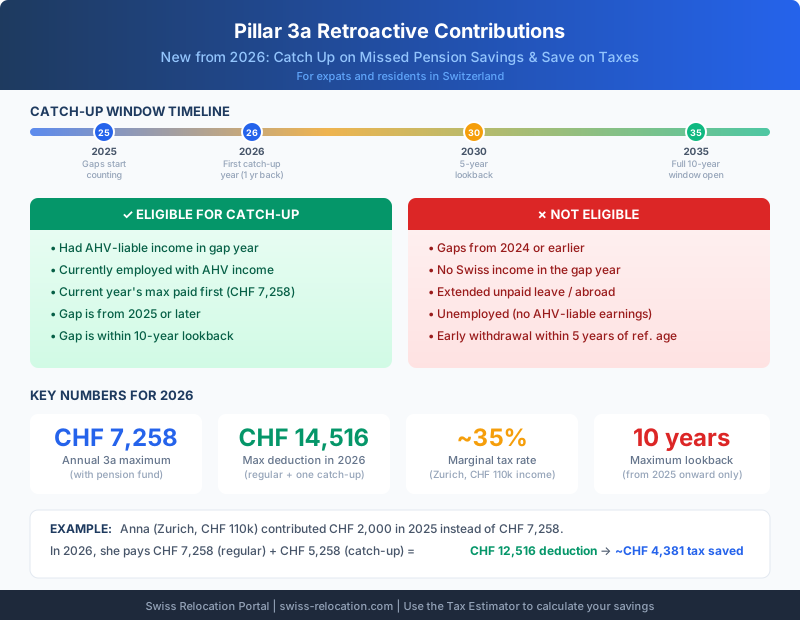
The lookback window is 10 years. In 2026, that means you can only catch up for 2025. By 2027, you could catch up for both 2025 and 2026. The full 10-year range will only be available starting in 2035. Gaps from 2024 and earlier are permanently lost — the old rules still apply to those years.
Year-by-Year: What You Can Actually Do
Because the rule only covers gaps from 2025 onward, the practical impact grows each year. Here is how the catch-up window expands:
| Tax Year | Catch-Up Window | Maximum Years to Recover |
|---|---|---|
| 2026 | 2025 only | 1 year |
| 2027 | 2025–2026 | 2 years |
| 2028 | 2025–2027 | 3 years |
| 2030 | 2025–2029 | 5 years |
| 2035 | 2025–2034 | 10 years (full window) |
One important constraint: you can only make one catch-up contribution per calendar year, in addition to your regular contribution. So even if you have gaps for 2025 and 2026, you cannot fill both in the same year. You would need to catch up for 2025 in one year and 2026 in the following year.
Contribution Limits for 2026
The pillar 3a maximum contribution depends on whether you are affiliated with a pension fund:
| Situation | 2025 Maximum | 2026 Maximum |
|---|---|---|
| Employed with pension fund (pillar 2) | CHF 7,258 | CHF 7,258 |
| Self-employed without pension fund | CHF 36,288 | CHF 36,288 |
These amounts are set by the Federal Council and adjusted periodically. The next adjustment is expected around 2027, when the maximum for employed persons may rise to approximately CHF 7,466 based on inflation indexing.
Real-World Example: How Tax Savings Add Up
Let us walk through a concrete scenario that many expats will recognize.
Profile: Anna, a German software engineer, relocated to Zurich in June 2025. She was overwhelmed by the move and only contributed CHF 2,000 to her pillar 3a in 2025 instead of the maximum CHF 7,258.
In 2026, Anna can:
- Make her regular 2026 contribution: CHF 7,258
- Make a catch-up contribution for 2025: CHF 5,258 (the gap between CHF 7,258 and her CHF 2,000 contribution)
- Total 2026 pillar 3a deduction: CHF 12,516
Tax savings comparison (Zurich, taxable income CHF 110,000):
| Scenario | Deductible Amount | Estimated Tax Savings |
|---|---|---|
| Regular contribution only | CHF 7,258 | ~CHF 2,540 |
| With 2025 catch-up | CHF 12,516 | ~CHF 4,381 |
| Additional savings | CHF 5,258 | ~CHF 1,840 |
At a marginal tax rate of approximately 35% in Zurich (combined federal, cantonal, and municipal), Anna saves an extra CHF 1,840 on her 2026 tax bill. The money also grows tax-free inside the pillar 3a until retirement.
The tax savings vary by canton. In a lower-tax canton like Zug, the marginal rate might be closer to 22%, yielding about CHF 1,157 in additional savings. In Geneva, with marginal rates approaching 40% for higher earners, the savings could exceed CHF 2,100.
What About Expats Who Arrived Before 2025?
This is the critical limitation. If you moved to Switzerland in 2020 and missed your pillar 3a contributions for 2020 through 2024, those gaps are permanently closed. The retroactive rule only applies to contribution years from 2025 onward.
However, there is still an indirect benefit. Starting now, you can be strategic about your future contributions. If you anticipate a year with lower income — perhaps due to parental leave, a job change, or a sabbatical — you can skip or reduce your pillar 3a contribution that year and catch up later when your income (and marginal tax rate) is higher. This was never possible before.
Situations Where Catch-Up Is Not Allowed
The law includes several exclusions that expats should be aware of:
Periods abroad without Swiss income. If you spent a full year working outside Switzerland (for example, on a temporary assignment), you had no AHV-liable income in Switzerland that year and cannot catch up for it.
Extended parental leave. If you took unpaid leave for a full calendar year and had no AHV-liable income, that year is not eligible for a catch-up contribution.
Unemployment. Periods of unemployment where you had no earned income subject to AHV do not qualify. Unemployment insurance benefits are not considered AHV-liable earned income for this purpose.
Early withdrawal penalty. If you withdraw pillar 3a capital within five years before reaching the statutory reference age (currently 65 for men, 64 for women), you lose the right to make retroactive contributions going forward.
How to Make a Retroactive Contribution: Step by Step
The process is straightforward but requires attention to documentation:
Step 1: Check Your Contribution History
Review your pillar 3a statements from 2025 onward. Identify any years where you contributed less than the maximum. Your bank or insurance provider can confirm exact amounts.
Step 2: Calculate the Gap
Subtract your actual contribution from the maximum for that year. For 2025, the maximum was CHF 7,258. If you paid CHF 4,500, your gap is CHF 2,758.
Step 3: Make the Current Year's Full Contribution First
Transfer CHF 7,258 (or your applicable maximum) to your pillar 3a account for 2026. This must be done before the catch-up payment.
Step 4: Make the Catch-Up Payment
Transfer the gap amount (CHF 2,758 in our example) as a separate, clearly designated catch-up contribution. Your pillar 3a provider should have a process for labeling this correctly. Contact them if the procedure is unclear.
Step 5: Keep Documentation for Your Tax Return
You will need confirmation from your provider showing both the regular and catch-up contributions. Both amounts are tax-deductible in the year they are paid. Ensure your tax return correctly reflects the combined deduction.
Strategic Tips for Expats
Open Multiple Pillar 3a Accounts
Swiss tax law allows you to hold up to five pillar 3a accounts (the commonly recommended number) and stagger withdrawals across different tax years at retirement. This strategy reduces the tax burden on lump-sum withdrawals. Starting early — even if contributions are small — is advantageous.
Coordinate with Your Pillar 2 Buy-In
If you also have gaps in your occupational pension (pillar 2), you may be tempted to buy into both simultaneously. Be aware that pillar 2 buy-ins and pillar 3a catch-ups are independent — making one does not affect the other. However, since both reduce taxable income, spreading them across different tax years can maximize the benefit if your income fluctuates.
Time Your Catch-Up for High-Income Years
Because the catch-up contribution is deductible in the year it is paid (not the gap year), you benefit most by making it in a year when your marginal tax rate is highest. If you expect a bonus, stock option exercise, or salary increase, that is the optimal year to close old gaps.
Consider the Cantonal Impact
Tax savings depend heavily on where you live. Use the Tax Estimator on our portal to model how a pillar 3a catch-up affects your specific tax situation in your canton and municipality.
How This Fits Into Switzerland's Three-Pillar System
For expats still getting familiar with Swiss retirement planning, here is the context. Switzerland's pension system rests on three pillars:
Pillar 1 (AHV/OASI): The state pension, funded by payroll deductions. In 2026, retirees will receive a 13th monthly payment for the first time, adding roughly 8.3% to annual AHV income. This is mandatory and automatic for employed persons.
Pillar 2 (BVG/LPP): The occupational pension, managed by your employer's pension fund. Contributions are split between employer and employee. Voluntary buy-ins are possible to close gaps, often with significant tax benefits.
Pillar 3a: The private, voluntary pension with annual contribution caps. Contributions are fully tax-deductible, and investment gains are tax-free until withdrawal. The new retroactive buy-in rule makes this pillar more flexible than ever.
Together, these three pillars aim to provide retirees with approximately 60–80% of their pre-retirement income. For expats who may not spend their entire career in Switzerland, maximizing pillar 3a is particularly important because it is fully portable — you can withdraw it when you leave Switzerland permanently (subject to a withholding tax that varies by canton).
Frequently Asked Questions
Can I catch up for years before 2025?
No. The retroactive contribution rule only applies to contribution gaps from 2025 onward. Any unused capacity from 2024 or earlier is permanently forfeited under the old rules.
What happens if I contributed zero in 2025?
You can catch up the full maximum for 2025, which is CHF 7,258 (assuming you are affiliated with a pension fund). Combined with your regular 2026 contribution of CHF 7,258, your total deductible amount would be CHF 14,516.
Can I catch up for multiple years in one go?
No. You can only make one catch-up contribution per calendar year, covering one gap year. If you have gaps for both 2025 and 2026, you would need two separate calendar years to close them.
Do I need a specific type of pillar 3a account?
No. The catch-up rule applies to both bank-based (investment) and insurance-based pillar 3a products. However, bank-based accounts generally offer more flexibility for varying contribution amounts.
Is there a deadline within the year?
Yes. Both regular and catch-up contributions must be made by December 31 of the tax year. Do not wait until the last day — bank transfers can take several business days to process, and contributions received after December 31 count for the following year.
How does this affect cross-border commuters (Grenzgänger)?
Cross-border commuters with G permits who are subject to Swiss AHV contributions may also be eligible, provided they meet all five conditions. However, cross-border tax treaties can complicate the deductibility of pillar 3a contributions. Check with a tax advisor familiar with your specific corridor (France-Switzerland, Germany-Switzerland, Italy-Switzerland, or Austria-Switzerland).
What This Means for You: Practical Checklist
If you are an expat in Switzerland, here is what to do right now:
- Review your 2025 pillar 3a statement. Did you contribute the full CHF 7,258? If not, calculate the gap.
- Open a pillar 3a account if you do not have one. Banks like UBS, PostFinance, Viac, Finpension, and Frankly offer competitive investment-based accounts.
- Make your full 2026 contribution first. Transfer CHF 7,258 to your pillar 3a as early as possible. Starting in January means more time invested in the market.
- Make the 2025 catch-up contribution. Transfer the gap amount as a separate, designated top-up.
- Document everything. Keep confirmation of both payments for your 2026 tax return.
- Use the Tax Estimator to model your savings. Enter your canton, income, and contribution amounts to see your exact benefit.
- Set a recurring reminder. Every December, review whether you have contributed the maximum for the current year. If not, you now know you can catch up — but only within the rules.
Looking Ahead
The pillar 3a retroactive buy-in is part of a broader trend toward flexibility in Swiss retirement planning. Combined with the new 13th AHV pension payment and ongoing discussions about pension fund reform, Switzerland is gradually modernizing its system to better accommodate mobile, international workforces.
For expats, these changes mean one thing: there are more tools than ever to build a solid retirement foundation in Switzerland — even if you got a late start. The key is acting before the window closes. Gaps accumulate quickly, and the 10-year lookback means today's missed contribution cannot be recovered after 2035.
Estimate how much you could save by making a catch-up contribution this year with our Tax Estimator. And if you are still sorting out your residence status, check the Permit Checker to understand how your permit type affects your tax obligations and pension eligibility.
Premium Tool
Calculate Your Swiss Tax Savings
Use our canton-by-canton tax estimator to see exactly how much you'll pay — and how the 2026 reform affects your household.
This portal is built by an expat, for expats. If it saved you time, buy me a coffee.
Buy me a coffee