Swiss Health Insurance for Expats 2026: Premiums, Cantons, and How to Save Up to CHF 1,700 Per Year
Swiss Health Insurance for Expats 2026: Premiums, Cantons, and How to Save Up to CHF 1,700 Per Year
If you've recently moved to Switzerland — or you're planning to — health insurance is one of the first bureaucratic hurdles you'll face. Unlike many countries where employer-sponsored coverage is the norm, Switzerland requires every resident to purchase their own basic health insurance (Grundversicherung) under the Federal Health Insurance Act, known as the KVG (Krankenversicherungsgesetz). There's no opt-out, no grace period beyond 90 days, and the price you pay depends heavily on where you live, which insurer you choose, and how you structure your policy.
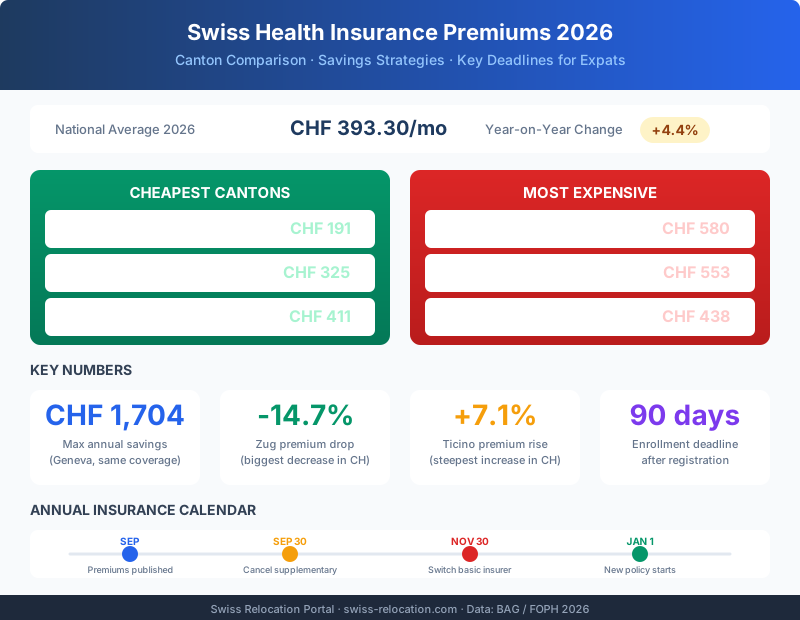
In 2026, premiums are rising again — an average of 4.4% nationwide — but the differences between cantons are staggering. An adult in Zug can pay as little as CHF 191 per month, while someone in Geneva might pay CHF 580 for the same coverage level. That's a difference of nearly CHF 4,700 per year for identical benefits.
This guide breaks down everything you need to know: how the system works, what you'll actually pay in 2026, and the concrete steps you can take to minimize your costs.
How Swiss Health Insurance Works: The Basics
Switzerland's healthcare system is built on a simple but sometimes confusing principle: basic coverage is mandatory and standardized, but it's delivered by private insurers competing on price. Every insurer must accept every applicant for basic insurance (KVG) regardless of age, health status, or pre-existing conditions. They cannot charge you more because you have a chronic illness or because you're 55 instead of 25 — though premiums do vary by age band and canton.
What KVG Covers
The basic insurance package is defined by law and is identical across all insurers. It includes doctor visits (general practitioners and specialists), hospital stays in a general ward in your canton of residence, prescription medications on the official list (Spezialitätenliste), maternity care including prenatal and postnatal checkups, physiotherapy when prescribed by a doctor, certain preventive screenings, and emergency treatment anywhere in Switzerland.
What it does not cover includes dental care (except for accidents or specific conditions), private or semi-private hospital rooms, alternative medicine beyond a limited list, and eyeglasses and contact lenses for adults. Note that since 2022, psychologists can bill KVG directly under the Anordnungsmodell — basic psychotherapy is covered with a doctor's referral (up to 30 sessions initially).
The 90-Day Rule: Don't Miss It
From the day you register your residency at your local Gemeinde (municipality), you have exactly 90 days to arrange basic health insurance. This isn't a suggestion — it's a legal requirement. If you miss the deadline, your canton will assign you to an insurer, often one of the most expensive in your region, and your coverage will be backdated to your arrival date. That means you'll receive a large, immediate bill covering all the months you went without insurance.
For most expats arriving on a B or L permit, the clock starts ticking the moment you complete your Einwohnerkontrolle (resident registration). Don't wait until you've settled in to start comparing insurers — begin researching before you arrive.
2026 Premiums: What You'll Actually Pay
The Federal Office of Public Health (BAG) announced that premiums are increasing by an average of 4.4% in 2026, bringing the national average to CHF 393.30 per month for an adult. But this average masks enormous variation.
Canton-by-Canton Breakdown
The canton you live in is the single biggest factor determining your premium. Healthcare costs vary because of differences in the local density of medical providers, the age profile of the population, and how much the canton itself subsidizes hospital infrastructure.
Here are the 2026 realities for the cantons most popular with expats, based on an adult with the highest deductible (CHF 2,500) and no accident coverage:
Zug stands out as the clear winner. The cheapest option — Concordia HMO at CHF 191 per month — is the lowest premium in the entire country. Even the most expensive plan in Zug (Swica Standard at CHF 281/month) costs less than the cheapest plan in Geneva. The reason is remarkable: the Canton of Zug covers approximately 99% of hospital costs from cantonal funds, dramatically reducing the burden on insurers.
Zurich (Horgen region) offers a range from CHF 325/month (Atupri HMO) to CHF 418/month (Swica Standard), with potential annual savings of CHF 1,116 by choosing the cheapest insurer.
Basel ranges from CHF 411/month (CSS Gesundheitspraxis) to CHF 553/month (Swica Standard), with annual savings potential of CHF 1,704.
Geneva is the most expensive canton for health insurance. The cheapest option is Assura PharMed at CHF 438/month, while the most expensive reaches CHF 580/month (Swica Standard). That's an annual savings potential of CHF 1,704 just by switching insurers — for identical basic coverage.
The Biggest Movers in 2026
Not all cantons are moving in the same direction. Ticino faces the steepest increase at 7.1%, pushing its already-high premiums even further. By contrast, Zug residents are seeing an extraordinary 14.7% decrease in average premiums — a rare and welcome development driven by the canton's strong hospital funding model.
Children's Premiums
Children's premiums are significantly lower, typically ranging from CHF 100 to CHF 150 per month. For families with multiple children, this still adds up quickly. A family of four in Zurich can easily spend CHF 1,200 to CHF 1,500 per month on health insurance alone — a significant line item that many expats underestimate when calculating their relocation budget.
Five Strategies to Reduce Your Premium
The good news is that Swiss health insurance offers several legitimate levers to bring your costs down. Here's how to use them effectively.
1. Choose a Higher Deductible
Your annual deductible (Franchise) is the amount you pay out of pocket before insurance kicks in. The options are CHF 300, 500, 1,000, 1,500, 2,000, or 2,500. After your deductible is met, you still pay 10% of costs (the Selbstbehalt) up to a maximum of CHF 700 per year.
The math is straightforward for healthy adults: a CHF 2,500 deductible typically saves CHF 100 to CHF 150 per month compared to the CHF 300 minimum. Over a year, that's CHF 1,200 to CHF 1,800 in premium savings. Even if you use CHF 2,500 in healthcare, you'd still break even or come out ahead in most cantons. For young, healthy expats who visit the doctor once or twice a year, the highest deductible is almost always the right choice.
For families with young children or anyone with a chronic condition requiring regular treatment, the CHF 300 or CHF 500 deductible may make more sense — run the numbers based on your actual expected usage.
2. Select a Managed Care Model
Swiss insurers offer several insurance models that restrict how you access care in exchange for lower premiums:
HMO (Health Maintenance Organization) requires you to visit a specific HMO group practice as your first point of contact. Savings: typically 15–25% below the standard model.
Telmed (Telephone Medicine) requires you to call a medical hotline before visiting a doctor. The hotline triages your situation and directs you to appropriate care. Savings: typically 10–20%.
Family Doctor Model (Hausarztmodell) requires you to see your chosen GP first for all non-emergency care. Savings: typically 5–15%.
These models don't change what's covered — the benefits remain identical to the standard model. They only change how you access the system. For most expats, the Telmed model offers the best balance of savings and flexibility.
3. Compare Insurers Every Year
Because basic coverage is identical by law, there is zero medical reason to stay with an expensive insurer. The only differences are price and customer service. Use the official BAG premium calculator at priminfo.admin.ch or comparison tools like Comparis.ch and moneyland.ch to see exact prices for your canton, age, and preferred model.
As the data shows, the gap between the cheapest and most expensive insurer in the same canton can exceed CHF 1,700 per year. That's real money for doing nothing more than filling out a form.
4. Drop Accident Coverage If You're Employed
If you work at least eight hours per week for the same employer, your workplace accident insurance (UVG) already covers you for both occupational and non-occupational accidents. In this case, you can exclude accident coverage from your KVG policy (called "ohne Unfalldeckung"), saving approximately CHF 5 to CHF 20 per month.
Be careful with this one: if you lose your job, you need to add accident coverage back to your health insurance within 31 days. Set a reminder if your employment situation changes.
5. Don't Overspend on Supplementary Insurance
Supplementary insurance (Zusatzversicherung/VVG) covers extras like private hospital rooms, dental, alternative medicine, and better coverage abroad. Unlike basic insurance, supplementary insurers can reject applicants based on health status and can set prices freely.
Many expats buy supplementary coverage out of habit or fear, then never use it. Before signing up, honestly assess what you need. If you have healthy teeth, don't need a private hospital room, and don't use alternative medicine, you may be paying CHF 100 to CHF 300 per month for peace of mind you don't need.
Some supplementary policies do offer genuinely useful benefits — Swica's gym reimbursement of up to CHF 1,300 annually and Helsana's glasses contribution of up to CHF 500 are popular among expats. But calculate the cost-benefit carefully.
Key Deadlines Every Expat Must Know
Swiss health insurance operates on an annual cycle with firm deadlines. Missing them can cost you money or lock you into unfavorable coverage.
Within 90 days of arrival: Enroll in basic health insurance. No exceptions.
September (each year): The BAG publishes the following year's premium rates. This is when you start comparing.
November 30: Deadline to cancel your current basic insurance policy and switch to a new insurer for January 1. Your cancellation letter must be received (not postmarked) by this date.
September 30: Typical deadline to cancel supplementary insurance policies. Check your specific contract, as terms vary.
January 1: New insurance year begins. Any changes you've made take effect.
March 31: In some cantons, this is the deadline to request premium subsidies (Prämienverbilligung/IPV) for the current year.
The November 30 Switching Deadline
This is the most important date in the Swiss health insurance calendar. Every autumn, when the BAG publishes new premium rates, you should compare your current plan against alternatives. If a cheaper option exists with equivalent model and deductible, switch. The process is simple: send a registered letter (Einschreiben) canceling your current policy, then apply with your new insurer. The new insurer cannot reject you for basic coverage.
Many expats set themselves an annual "insurance check" reminder for early October. Spending 30 minutes comparing premiums can save hundreds or even thousands of francs per year.
Special Situations for Expats
EU/EFTA Nationals: The Exemption Option
If you're an EU/EFTA citizen working in Switzerland but with family members remaining in an EU country, you may be able to opt out of Swiss health insurance and remain on your home country's system under certain conditions. This is handled through the S1 form and is particularly relevant for cross-border commuters (Grenzgänger/frontaliers). The rules vary by canton, and you must apply for an exemption within three months of becoming subject to Swiss insurance.
This option can save significant money if your home country's system is cheaper, but it comes with trade-offs: you may face longer waiting times, different coverage levels, and complications if you need treatment in Switzerland.
Self-Employed Expats
If you're self-employed, you won't have employer-provided accident coverage (UVG). You'll need to include accident coverage in your KVG policy and may want to consider supplementary accident insurance for loss of earnings, since the basic insurance only covers medical costs, not income replacement.
Leaving Switzerland
When you deregister from your Gemeinde and leave Switzerland, your insurance obligation ends on your departure date. Contact your insurer with your deregistration confirmation (Abmeldebestätigung) to cancel your policy. You're entitled to a pro-rata refund for any prepaid premiums.
The Real Cost: Putting It All Together
Let's look at what a typical expat actually pays. Consider a 35-year-old professional living in Zurich, employed full-time, choosing a Telmed model with a CHF 2,500 deductible and no accident coverage:
The cheapest option would be approximately CHF 290 to CHF 330 per month, or around CHF 3,500 to CHF 4,000 per year. If this person visits the doctor twice a year and spends CHF 500 total on healthcare, they'd pay CHF 500 out-of-pocket plus their premiums, totaling roughly CHF 4,000 to CHF 4,500 for the year.
Now compare that same person in Geneva: the floor is approximately CHF 400 to CHF 440 per month, or CHF 4,800 to CHF 5,300 per year in premiums alone. The canton you choose to live in can easily represent a CHF 1,000 to CHF 2,000 annual difference in health insurance costs — a factor worth considering when deciding between Zurich, Basel, and Geneva.
Premium Subsidies: You Might Qualify
Switzerland offers premium subsidies (Prämienverbilligung or IPV — individuelle Prämienverbilligung) for residents whose health insurance costs represent a disproportionate share of their income. The thresholds and amounts vary by canton, but many expats — particularly those in expensive cantons with moderate incomes, single parents, or families with children — are eligible and don't realize it.
Each canton manages its own subsidy program. In some cantons (like Zurich), you must proactively apply. In others (like Zug), the cantonal tax office automatically identifies eligible residents. Check with your Gemeinde or cantonal social insurance office to see if you qualify. The subsidy can cover a significant portion of your premium — in some cases, the entire amount for low-income residents.
Frequently Asked Questions
Can I keep my home country's health insurance instead of buying Swiss KVG?
Generally no. Swiss law requires all residents to have KVG coverage, regardless of any international insurance you already hold. The only exceptions are for EU/EFTA nationals in specific cross-border situations, diplomats, and employees of certain international organizations. If you believe you qualify for an exemption, you must apply within three months of registration.
What happens if I get sick before my insurance starts?
If you fall ill or have an accident during your first 90 days (before your insurance is arranged), your coverage will be backdated to your arrival date once you do sign up. This means the insurer will cover treatment you received during this period, minus your deductible and cost-sharing. However, relying on this is risky — arrange coverage as early as possible.
Is it true that basic coverage is identical across all insurers?
Yes. The benefits defined under KVG are set by federal law and are exactly the same whether you pay CHF 191/month in Zug or CHF 580/month in Geneva. The differences between insurers are price, customer service quality, digital tools, and the availability of managed care models. There is no medical reason to choose a more expensive insurer for basic coverage.
Can I switch insurers mid-year?
Only under specific circumstances. If your insurer raises premiums mid-year (rare) or if you move to a new canton, you may switch outside the standard November 30 deadline. Otherwise, you're locked in for the calendar year.
Should I choose the highest deductible?
For healthy adults who visit the doctor once or twice a year, the CHF 2,500 deductible almost always saves money, even in years when you hit the full deductible. For people with chronic conditions, pregnant women, or families with young children who frequently visit the pediatrician, a lower deductible (CHF 300 or CHF 500) often makes more financial sense. Calculate your expected annual healthcare costs and compare total costs (premiums + deductible + 10% cost-sharing) under different scenarios.
Do I need supplementary insurance?
It depends on your needs and risk tolerance. Many expats live comfortably with only basic KVG coverage. Supplementary insurance is most valuable if you want a private or semi-private hospital room, need dental coverage, use alternative medicine regularly, or travel frequently outside Europe (KVG provides limited international coverage). Always compare the annual cost of the supplementary premium against the realistic probability of using the covered services.
Practical Checklist for New Arrivals
Here's your step-by-step action plan for getting health insurance sorted efficiently:
Before arriving: Research insurers and premiums for your destination canton using priminfo.admin.ch. Identify two or three options in your preferred model and deductible level.
Week 1 after registration: Request quotes from your shortlisted insurers. Most offer online applications. Gather your residence permit, registration confirmation, and employment contract.
Within 30 days: Submit your application. Don't wait until day 89 — processing takes time, and starting early gives you a buffer if documents are missing.
After enrollment: Set up a standing order (Dauerauftrag) from your Swiss bank account for monthly premium payments. Missing payments can lead to debt collection and, in extreme cases, a freeze on non-emergency care.
Every October: When new premiums are published, spend 30 minutes comparing your current plan to alternatives. Switch by November 30 if a better deal exists.
Use our Tax Estimator to see how your health insurance premiums fit into your overall Swiss tax picture — in most cantons, KVG premiums are tax-deductible up to certain limits, reducing your effective cost.
Looking Ahead
Swiss health insurance premiums have risen steadily for decades, and 2026 continues the trend at 4.4% nationally. Several political initiatives are working through the Swiss system — including proposals to cap premiums at 10% of household income and to give cantons more power to regulate hospital costs — but none are likely to take effect before 2028 at the earliest.
For now, the best defense against rising costs is proactive comparison shopping, choosing the right deductible for your health profile, and not paying for supplementary coverage you don't use. A few hours of research each autumn can save you well over CHF 1,000 per year — money that's far better spent enjoying your new life in Switzerland.
Need help understanding how health insurance premiums affect your overall tax situation? Try our Tax Estimator to calculate your total Swiss tax burden, including deductions for insurance premiums. You can also use the Permit Checker to verify which residence permit applies to your situation, as permit type can affect your insurance options.
Sources
- BAG/FOPH: Approved Health Insurance Premiums 2026
- Priminfo.admin.ch: Official Premium Calculator
- Comparis.ch: Health Insurance Comparison Switzerland 2026
- Moneyland.ch: Swiss Health Insurance 2026 — Premiums and Savings Tips
- KVG (Federal Health Insurance Act) — SR 832.10
- BAG: Psychotherapy — New Regulations from July 2022 (Anordnungsmodell)
- Canton of Zug: Health Insurance and Premium Subsidies
- The Local: Swiss Health Insurance Premiums — What Changes in 2026
Premium Tool
Calculate Your Swiss Tax Savings
Use our canton-by-canton tax estimator to see exactly how much you'll pay — and how the 2026 reform affects your household.
This portal is built by an expat, for expats. If it saved you time, buy me a coffee.
Buy me a coffee