Switzerland Individual Taxation Reform 2026: What the End of the Marriage Penalty Means for Expats
Switzerland Individual Taxation Reform 2026: What the End of the Marriage Penalty Means for Expats
On March 8, 2026, Switzerland voted to fundamentally change its tax system. With 54.26% of voters saying "yes," the Federal Act on Individual Taxation (Individualbesteuerung) was approved — ending decades of joint taxation for married couples and eliminating the notorious "marriage penalty" (Heiratsstrafe). If you're an expat living in Switzerland, planning to move here, or married to someone who is, this reform will affect your financial life in ways big and small.
But here's the thing: the new rules won't kick in tomorrow. Implementation is expected by January 1, 2032 at the earliest. That gives you time to understand the changes, plan accordingly, and potentially save a significant amount of money when the switch happens.
Let's break it all down.
What Was the "Marriage Penalty" and Why Did It Matter?
Under the old system — which still applies today — married couples in Switzerland file a single, joint tax return. Both spouses' incomes are added together, and the progressive tax rates are applied to that combined total. Because Switzerland uses a steeply progressive tax system, lumping two incomes together often pushes couples into a higher tax bracket than they'd face individually.
Here's a simplified example. Imagine you and your spouse each earn CHF 100,000 per year. Under joint taxation, the tax authorities see a household income of CHF 200,000 and apply the progressive rate to the full amount. An unmarried couple living together? Each person is taxed individually on CHF 100,000 — a much lower effective rate.
This discrepancy is what the Swiss call the "marriage penalty." It's been a political hot potato for decades. The Federal Supreme Court actually declared it unconstitutional back in 1984, but it took over 40 years — and multiple failed reform attempts — to finally fix it.
For expats, this mattered in very practical ways. Some couples genuinely delayed getting married to avoid the tax hit. Others structured their finances specifically to mitigate it. Now, that entire calculus changes.
What Exactly Did the Referendum Approve?
The March 8 vote approved a shift from joint household taxation to individual taxation for all adults in Switzerland. Here's what that means in practice:
Every adult files their own tax return. Whether you're married, in a registered partnership, or single — you file individually. No more joint returns for married couples.
Each person is taxed on their own income. Your tax bracket is determined solely by your personal income and wealth, not your household's combined figures.
This applies at all three levels. Federal, cantonal, and municipal taxes will all shift to individual assessment. This is important because cantonal and municipal taxes often make up the lion's share of your total tax bill.
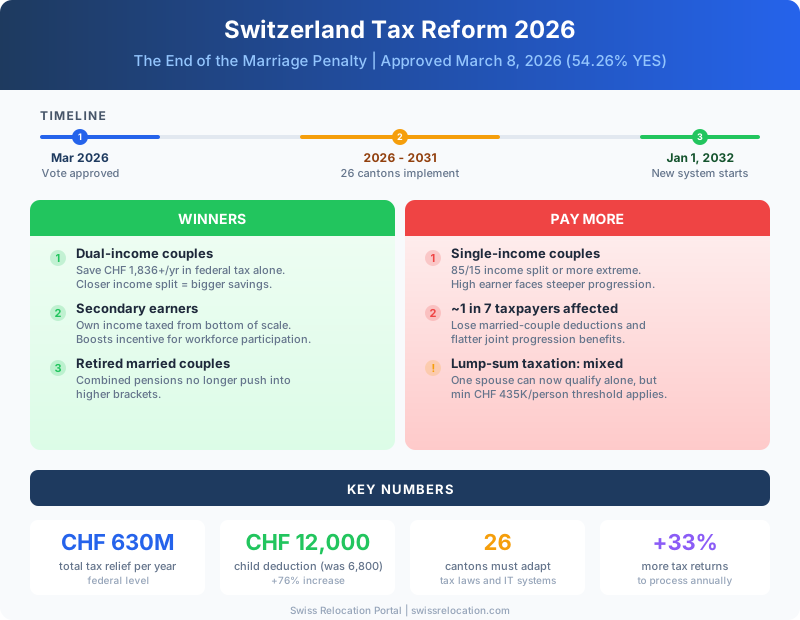
Child-related deductions are split equally. Under the new system, tax deductions for children are shared 50/50 between parents. The federal child deduction will also increase from CHF 6,800 to CHF 12,000 per child — a meaningful bump.
Asset allocation follows civil law. For jointly held assets (like a shared bank account), the default is an equal split for tax purposes, unless you report otherwise.
Who Benefits from the Reform?
Not everyone will see lower taxes. The impact depends heavily on your family situation and income split. Let's look at the winners and losers.
Winners: Dual-Income Couples
If both you and your spouse work and earn roughly similar incomes, you're the biggest beneficiary. The closer your incomes are to each other, the more you'll save.
A concrete example from the Federal Council's analysis: a married couple with gross salaries of CHF 100,000 and CHF 80,000 could save approximately CHF 1,836 per year in direct federal taxes alone. Add cantonal and municipal savings, and the total relief could be several thousand francs annually.
The reform is estimated to reduce the total tax burden on Swiss taxpayers by approximately CHF 630 million per year in direct federal tax.
Winners: Retired Married Couples
Pensioners who both receive AHV and pension income are also expected to benefit. Under the old system, combining two pension incomes often triggered the marriage penalty. Individual taxation fixes this.
Winners: Secondary Earners (Often Women)
Here's a subtler but important effect. Under joint taxation, the second earner's income was effectively taxed at the household's marginal rate — which could be quite high. This created a disincentive for the lower-earning spouse (statistically more often women) to work or to work full-time.
Under individual taxation, each person's income starts at the bottom of the progression ladder. This makes part-time or full-time work more financially rewarding for the secondary earner and is expected to boost female workforce participation.
Winners: Low-to-Middle-Income Singles
The revised federal tax scale includes lower rates for low and middle incomes, so even unmarried individuals in these brackets may see modest tax reductions.
Losers: Single-Income Couples
If one spouse earns most or all of the household income while the other stays home or earns very little, you may actually pay more under the new system. Here's why: previously, the joint return's married-couple deductions and flatter progression partially offset the penalty. Under individual taxation, the high earner will be taxed on their full income with steeper progression, while the non-working spouse has little or no income to benefit from the low brackets.
The Federal Council estimates that roughly one in seven taxpayers will pay more under the new system. Couples with an income split of around 85/15 or more extreme are most likely to be affected.
Special Case: Lump-Sum Taxation (Pauschalbesteuerung)
For wealthy expats taxed on a lump-sum basis, the reform introduces both opportunities and risks. On the positive side: under the new system, only one spouse needs to qualify for lump-sum taxation. Previously, if one spouse worked in Switzerland, the couple couldn't benefit from lump-sum taxation at all. This opens the door for mixed arrangements — one spouse on a lump-sum, the other on ordinary taxation.
However, each individual must now meet the minimum threshold for lump-sum taxation independently. At the federal level, that's at least CHF 435,000 in taxable income per person (not per couple). This could raise the overall tax burden for married couples currently near the minimum thresholds.
Impact Comparison: Before vs. After
| Aspect | Current System (Joint) | New System (Individual) |
|---|---|---|
| Tax filing | One joint return per couple | Separate return per person |
| Income assessment | Combined household income | Individual income only |
| Tax brackets | Applied to combined income | Applied to personal income |
| Child deductions | Claimed by household | Split 50/50 between parents |
| Federal child deduction | CHF 6,800 per child | CHF 12,000 per child |
| Marriage deduction | Available (CHF 2,700 federal) | Eliminated |
| Dual-income couples | Often penalized | Significant savings |
| Single-income couples | Partially protected | May pay more |
| Unmarried couples | Already taxed individually | No change |
When Does It Take Effect?
Here's the timeline you need to know:
March 8, 2026: Voters approve the reform.
2026–2031: Implementation period. The federal government finalizes the legislative framework. All 26 cantons must amend their tax laws, update IT systems, retrain administrators, and redesign tax forms. Cantonal tax administrations will need to process approximately one-third more tax returns under the new system.
January 1, 2032 (at the latest): The new system enters into force. Finance Minister Karin Keller-Sutter confirmed this deadline on the day of the vote. Some cantons may implement earlier if their systems are ready, but the universal deadline is 2032.
Tax year 2032: The first tax returns under individual taxation are filed.
This means you have roughly six years to plan. That's a generous runway, but don't sleep on it — especially if you're in a category that might pay more under the new system.
What Should Expats Do Now? A Practical Checklist
Even though the reform won't take effect until 2032, smart planning starts today. Here's what to consider:
1. Understand Your Income Split
Calculate what percentage of your household income each spouse earns. If you're a dual-income couple with a roughly 50/50 to 70/30 split, you'll likely benefit. If you're at 85/15 or more extreme, start modeling the potential impact.
2. Review Your Employment Situation
If the secondary earner in your household has been working part-time or not at all, the math changes. Under individual taxation, additional income for the lower-earning spouse is taxed at lower progression — making it more financially attractive to increase working hours.
3. Reassess Pension and Retirement Planning
Pillar 2 (occupational pension) and Pillar 3a (private pension) contributions are deducted from individual income. Under individual taxation, each spouse's contributions reduce their own tax base. This could make it beneficial for both spouses to maximize contributions independently.
4. Think About Asset Allocation
Jointly held assets will be split 50/50 for tax purposes by default. If your wealth is unevenly distributed between spouses, you may want to review ownership structures and consider whether adjustments make sense.
5. Consult a Tax Advisor
This is genuinely one of those situations where professional advice pays for itself. Every couple's situation is different, and the cantonal variations add another layer of complexity. A qualified Swiss tax advisor can model the exact impact on your specific situation and help you plan the transition.
6. Watch for Cantonal Developments
Each canton will implement the reform on its own timeline and with its own adjustments to tax scales and deductions. Cantons with higher tax rates (like Zurich, Geneva, or Vaud) may see the biggest absolute changes for residents. Keep an eye on announcements from your cantonal tax authority (Steueramt / Administration fiscale).
How Does This Compare to Other Countries?
Switzerland was actually one of the last Western countries to tax married couples jointly. Most of Europe moved to individual taxation decades ago.
Germany still uses a joint taxation system with income splitting (Ehegattensplitting), though it's been debated for years. France uses a family quotient system. The United States offers both joint and individual filing options.
By adopting individual taxation, Switzerland is aligning itself with the majority approach in OECD countries — and with the principle that tax treatment shouldn't depend on marital status.
Other 2026 Tax Changes You Should Know About
While the individual taxation reform is the headline, several other tax changes took effect in 2026 that are worth noting:
Mileage deduction increase: The compensation rate for using a personal car for business purposes increased from CHF 0.70 to CHF 0.75 per kilometer.
CRS 2.0 / CARF for crypto: Switzerland has introduced the Common Reporting Standard 2.0 and the Crypto-Asset Reporting Framework, enabling automatic exchange of information on crypto assets with other countries. If you hold cryptocurrency, your Swiss bank will report it to tax authorities internationally.
Vaccination franchise exemption: Certain vaccinations (diphtheria, tetanus, pneumococcal, meningitis) are now exempt from the health insurance deductible (Franchise).
Social security rates unchanged: AHV/IV/EO contributions remain at 5.3% each for employee and employer (10.6% total). ALV stays at 1.1% each (2.2% total), with a ceiling of CHF 148,200 per year.
Frequently Asked Questions
Will I need to file two tax returns as a married couple?
Yes, once the reform takes effect (expected January 1, 2032). Each spouse will submit their own individual tax return, just as unmarried persons do today. This applies at the federal, cantonal, and municipal levels. You'll declare your own income, your own assets, and your share of any jointly held property.
How will child deductions work under individual taxation?
Child-related deductions will be split equally (50/50) between both parents. The good news: the federal child deduction increases significantly from CHF 6,800 to CHF 12,000 per child. So even though you're sharing the deduction, the higher amount partially compensates.
I'm an expat on source tax (Quellensteuer). Does this affect me?
Yes, it will eventually apply to source-taxed individuals as well. The details of how withholding tax calculations will change for married couples are still being worked out at the cantonal level. If you're currently on source tax, your employer's payroll system will need to adjust how it calculates withholding for married employees.
Should I delay getting married until the new system is in place?
This is a personal decision that depends on many factors beyond taxes. However, from a purely tax perspective: if both you and your partner earn similar incomes, you may want to consider that getting married now means joint taxation until 2032, while waiting would avoid the marriage penalty altogether. Consult a tax advisor for your specific numbers.
What happens to couples where one spouse is a Swiss resident and the other is not?
Cross-border situations will be governed by the same individual taxation principles, but double taxation agreements (DTAs) will continue to apply. The non-resident spouse's income may still be factored in for rate-setting purposes (known as the "progression reservation"). This is an area where professional advice is especially important.
Key Takeaways
The reform is approved but not yet in effect. Switzerland voted "yes" on March 8, 2026, but the new system takes effect January 1, 2032 at the earliest. You have time to prepare.
Dual-income couples are the biggest winners. If both spouses work and earn similar incomes, expect meaningful tax savings — potentially several thousand francs per year.
Single-income families may pay more. About one in seven taxpayers will face a higher burden. Couples with extreme income splits should plan ahead.
The child deduction nearly doubles. From CHF 6,800 to CHF 12,000 per child at the federal level — good news for families regardless of income split.
Cantonal implementation will vary. Each of Switzerland's 26 cantons will adapt the reform to its own tax system. Watch for canton-specific announcements over the next six years.
Start planning now. Review your income split, employment situation, pension contributions, and asset allocation. Professional tax advice is worth the investment for this transition.
Information is for general guidance only and does not constitute legal or financial advice. Tax implications vary depending on individual circumstances and canton of residence. Consult a qualified Swiss tax professional for advice tailored to your situation.
Sources
- Swiss Federal Council — Individual Taxation Referendum
- KPMG — Swiss Voters Approve Individual Taxation for Married Couples
- SWI swissinfo.ch — Vote on Individual Taxation
- DGVM — Switzerland Approves Historic Tax Reform
- RSM Switzerland — Individual Taxation of Spouses
- Zurich Insurance — Vote on the Marriage Penalty
- Lenz & Staehelin — Switzerland Introduces Individual Taxation
- PwC — Switzerland Individual Taxes on Personal Income
Premium Tool
Calculate Your Swiss Tax Savings
Use our canton-by-canton tax estimator to see exactly how much you'll pay — and how the 2026 reform affects your household.
This portal is built by an expat, for expats. If it saved you time, buy me a coffee.
Buy me a coffee