Winter Tires in Switzerland 2026: The Legal Grey Zone That Can Cost Expats CHF 100,000+
Winter Tires in Switzerland 2026: The Legal Grey Zone That Can Cost Expats CHF 100,000+
If you learned to drive somewhere warm — California, London, Madrid, Mumbai — the idea of swapping tires twice a year probably sounds like a Swiss eccentricity, up there with punctual trains and separate bins for glass by color. Then a Swiss colleague asks, with genuine concern, "have you had your winter tires put on yet?" and you realize this isn't a suggestion. It's a question with legal and financial teeth, even though — and this is the part that trips up almost every newcomer — Switzerland has no law requiring winter tires at all.
That contradiction is the whole story. Unlike Germany, Austria, or France, Switzerland does not mandate winter tires by date or by law. But if you drive on summer tires in winter conditions and something goes wrong, you can be fined, found liable, and left facing an insurance bill in the tens or even hundreds of thousands of francs — with your insurer legally entitled to refuse to cover it. This guide walks through exactly how the Swiss system works, what "O bis O" means, what counts as a real winter tire, when snow chains become mandatory, and what to actually do about it before the first snow falls.
The Surprising Truth: There's No Winter Tire Law in Switzerland
Search Swiss federal law for a winter tire mandate and you will not find one. The Federal Roads Office (ASTRA) and the Swiss Road Traffic Act (Strassenverkehrsgesetz, SVG) do not specify a tire type, a calendar window, or a temperature threshold. In this respect Switzerland is genuinely unusual among its neighbors: Germany has required "situational" winter tires since 2010, Austria has a hard date-based obligation, and France's "Loi Montagne" now mandates winter equipment in 34 alpine and mountain departments each winter.
Switzerland instead relies on a general principle already baked into traffic law: every driver must keep their vehicle "under control" and roadworthy for the conditions they are actually driving in. The relevant provision is a general duty-of-care standard, not a tire regulation — which means the responsibility for judging "is it safe to drive on these tires today" sits entirely with you, the driver. There is no bureaucrat, no checklist, no fixed date that makes the decision for you. That is exactly why so many expats get caught out: the absence of a rule feels like the absence of a risk, and it isn't.
But You're Still Fully Liable — Here's How the Grey Zone Actually Works
This is the section to read twice if you own or lease a car here. Because there is no explicit statute, Swiss courts and insurers apply the general negligence framework after the fact, which works against you in three separate ways if you were on unsuitable tires:
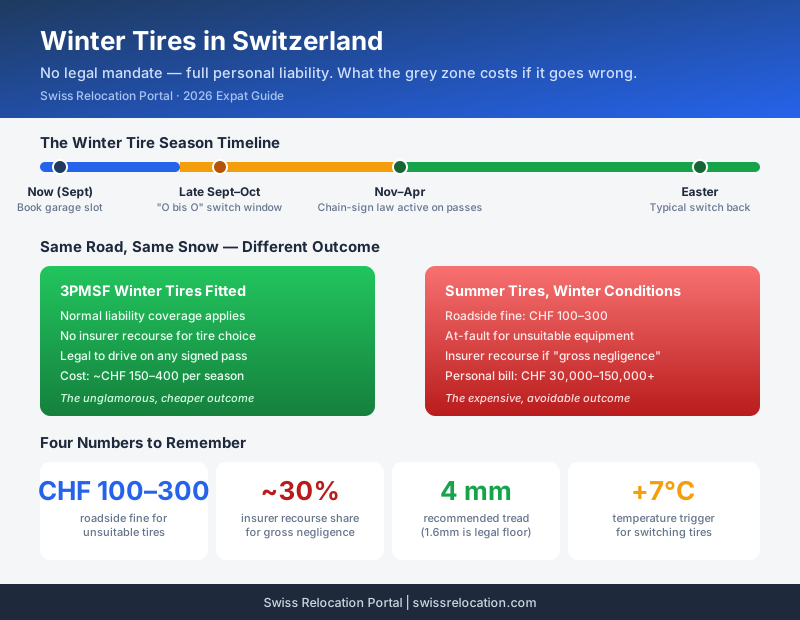
Police liability at the roadside. If your car cannot maintain control on a snowy or icy road — sliding, blocking traffic, unable to climb a hill — police can stop you, prohibit you from continuing, and issue an administrative fine, typically in the range of CHF 100 to 300, for driving a vehicle not equipped for the conditions.
Civil liability if you cause an accident. If your car with unsuitable tires causes a collision, you are the at-fault party for insufficient equipment, independent of anything else that happened on the road that day.
Insurance recourse for gross negligence (grobe Fahrlässigkeit). This is the expensive one. Swiss motor liability insurers (Haftpflichtversicherung) are required to pay out to injured third parties regardless of fault — but they are legally entitled to claim back a share of that payout from you personally if your own gross negligence caused the crash. Driving on bald or clearly unsuitable tires in snow or ice is a textbook example insurers and courts recognize as gross negligence. Recourse claims of around 30% of the total payout are commonly cited in Swiss consumer and insurance guidance. On a serious accident involving injury — where total claims (medical costs, lost income, pain and suffering) can run to CHF 300,000–500,000 or more — a 30% recourse share means a personal bill of CHF 100,000 to 150,000, payable by you, not your insurer. The tire change you skipped to save roughly CHF 150 becomes the most expensive shortcut you will ever take.
Comprehensive (Kasko) coverage for damage to your own vehicle can be reduced or denied on the same grounds. None of this requires a "winter tire law" to exist — it flows entirely from the ordinary negligence and duty-of-care rules that apply to every driver, every day, regardless of season.
The "O bis O" Rule and the 7°C Trigger
In the absence of a legal date, the Swiss driving-school and automobile-club establishment (TCS, the Touring Club Switzerland, plus ASTRA's own public guidance) have converged on an informal but widely cited rule of thumb: "O bis O" — Oktober bis Ostern, October to Easter. It is not law, but it is the reference point every Swiss driving instructor, garage, and insurer will quote back to you, and it is a reasonable proxy for what a court would consider "conditions where winter tires should have been fitted."
A more precise version used by tire professionals is temperature-based rather than calendar-based: once outside temperatures consistently drop below roughly +7°C, summer tire rubber compounds start to harden and lose grip even on dry roads, so the recommendation is to switch at that point regardless of the date on the calendar. In practice this means:
- Lowland cities (Zurich, Basel, Geneva, Bern): typically switch in the second half of October, back to summer tires around Easter or early April.
- Alpine and pre-alpine cantons (Graubünden, Valais, parts of Bern and Ticino): switch earlier, often late September to early October, and keep winter tires on longer into spring.
- Ticino south of the Alps: milder, but mountain routes (Gotthard, San Bernardino) can see snow well before the Ticino plain does — plan for the pass, not just the destination.
Garages get booked solid in the last two weeks of October every year. If this is your first Swiss autumn, book your tire appointment now rather than waiting for the first snowfall headline.
What Actually Counts as a Winter Tire
Not every tire marketed as "all-weather" or "M+S" will protect you legally or physically. Since October 2024, tires carrying only the old "M+S" (Mud and Snow) marking are no longer considered adequate winter equipment in Switzerland and across the EU — the marking was self-certified by manufacturers and never tested for actual snow performance. What matters now is the 3PMSF symbol (Three Peak Mountain Snowflake, a small snowflake-in-a-mountain icon on the sidewall), which certifies the tire passed an actual snow-traction test.
On tread depth, there is a gap between the legal floor and the practical standard:
- 1.6 mm is the absolute legal minimum tread depth for any tire, winter or summer, at any time of year.
- 4 mm is the minimum ASTRA and TCS actually recommend for winter tires to be effective in snow — below that, braking distance and grip degrade sharply even though the tire is still "legal."
A tire that is legal is not automatically a tire that will keep you, or the insurer's recourse claim, out of trouble. If your winter tires are older than six seasons or worn close to 4 mm, replace them before winter rather than after an incident forces the question.
Snow Chains: When the Signs Make the Choice for You
Switzerland has no general snow chain requirement either — but unlike the winter tire question, this one does become a hard, signed legal obligation in specific locations. Look for the round blue sign with a tire wrapped in a chain: where it is posted, typically on alpine passes and some valley roads during active winter conditions, fitting chains is mandatory, not optional, and police do enforce it. Common locations include high passes in Graubünden, Valais, and the Bernese Oberland during and after snowfall.
Practical rules of thumb for anyone driving into the Alps between November and April:
- Carry snow chains in the car even if you don't expect to need them — many passes only post the sign once conditions turn, and by then it's too late to buy a set.
- Practice fitting them once, in your driveway, before you need to do it at the roadside in the dark at -5°C.
- Four-wheel-drive and all-wheel-drive vehicles are not exempt from posted chain requirements — the sign applies to all vehicles unless stated otherwise.
How Switzerland Compares to Its Neighbors
This is often the most confusing part for expats who drive across borders for work, weekend trips, or a Grenzgänger commute — the rules change the moment you cross into Austria or France, even though nothing changes about the mountains around you.
| Country | Legal basis | Mandatory period | Typical fine |
|---|---|---|---|
| Switzerland | General duty-of-care (no tire-specific law) | None fixed — "O bis O" is informal guidance | CHF 100–300 (roadside); insurance recourse up to ~30% of claim if grossly negligent |
| Germany | Situational obligation (StVO) | No fixed dates — required whenever conditions demand (ice, snow, slush, frost) | Approx. €60–120 |
| Austria | Fixed statutory obligation | November 1 – April 15 | Approx. €35–5,000 depending on severity |
| France | "Loi Montagne" — mandatory in 34 designated departments | November 1 – March 31 (in designated zones only) | Approx. €135 |
The practical takeaway: if your commute or ski trips cross into Austria or France, you are bound by their fixed calendar dates the moment you cross the border, regardless of what Swiss law does or doesn't require at home. A car legally on the road in Zug in late October can be an offense the moment it crosses into Vorarlberg.
Renting, Leasing, and Company Cars — Who's Actually Responsible
If you're driving something you don't own outright, the winter tire question doesn't go away — it just changes who has to act:
- Leased vehicles: Most Swiss leasing contracts explicitly require winter tires during the winter months and often bundle a seasonal tire-hotel (storage and swap) service into the lease. Check your contract; failing to fit winter tires can itself be a contract breach independent of the traffic-law risk.
- Company cars: Employers providing a Firmenwagen typically arrange seasonal tire changes centrally — but the personal liability for grossly negligent driving described above still falls on you as the driver, not automatically on the employer, if you cause an accident.
- Short-term rentals: Swiss rental agencies fit winter tires as standard from October through spring, but always confirm this explicitly if renting for an alpine trip; budget or foreign-branch rental cars are not always compliant.
- Newly imported or foreign-registered cars: If you've just moved and are driving on foreign plates during your transition period, your foreign insurance policy's negligence and recourse clauses may differ from Swiss ones — read them before your first Swiss winter, not after an accident.
What This Means for You: Practical Checklist
- Book your tire-change appointment at a garage as early as you can — slots disappear fast once the first snow headline hits.
- Buy or confirm tires carrying the 3PMSF (Alpine symbol), not just "M+S" — the old marking alone is no longer treated as adequate.
- Check tread depth: replace anything under roughly 4 mm even though 1.6 mm is the bare legal floor.
- If you live in or regularly drive through an alpine canton, plan your switch for late September, not late October.
- Keep a set of snow chains in the car if you drive mountain passes, and practice fitting them before you need to.
- Read your motor liability and Kasko insurance policy's negligence clause now — know what "grobe Fahrlässigkeit" recourse actually means for your coverage.
- If you commute or travel across the border into Austria, Germany, or France, check that country's dated legal requirement separately — Swiss rules do not travel with you.
- If you're within your first year in Switzerland and still adjusting your overall cost-of-living budget, factor in the roughly CHF 150–400 twice-yearly cost of seasonal tire changes and storage — see our guide on cost of living by canton for how this fits into a realistic Swiss household budget.
Frequently Asked Questions
Is it actually illegal to drive on summer tires in winter in Switzerland?
Not by itself. There is no law banning summer tires in winter. What is illegal is driving a vehicle that cannot be safely controlled in the conditions you encounter — if summer tires cause you to lose control, block traffic, or cause an accident, you are liable for driving equipment unsuitable for the conditions, which carries the same practical consequences as a direct ban.
What exactly is "grobe Fahrlässigkeit" and why does it matter so much?
It's the Swiss legal standard for gross negligence. Ordinary negligence (a normal driving mistake) is covered by your insurance without recourse against you personally. Gross negligence — a clear, avoidable failure like driving on bald or summer tires into known snow or ice — allows your own insurer to reclaim a share of what it pays out to injured third parties directly from you, commonly cited around 30% of the total claim.
Do I need snow chains if I have good winter tires?
Only where explicitly signed. Winter tires handle the vast majority of Swiss winter driving, including most cities and lowland routes. Chains become legally mandatory only on specific alpine roads and passes when the posted sign is up, regardless of how good your winter tires are.
I'm only in Switzerland for one winter on an L permit — is it worth buying winter tires?
Yes, if you'll be driving at all between roughly October and April. The liability exposure described above applies identically to short-term residents and L-permit holders; there is no reduced standard for newcomers. If you don't expect to keep the car, ask about seasonal tire rental or a tire-hotel service through your garage rather than buying a set outright.
Does this affect motorcycles, vans, or company fleet vehicles the same way?
The same duty-of-care principle applies to any motor vehicle, though the specific tire specifications differ by vehicle class. Commercial and fleet vehicles often have separate seasonal maintenance contracts, but the driver's personal liability exposure for gross negligence is not eliminated by having a company-managed vehicle.
Where can I find the official alpine pass and chain-requirement status in real time?
Cantonal road authorities and the TCS traffic information service publish live pass status, including active chain requirements, throughout the winter season. Check before any alpine trip between November and April rather than relying on general seasonal assumptions.
Getting your paperwork and practical setup right in your first Swiss winter is part of the same learning curve as permits, taxes, and registration. If you're still working through the basics of settling in, our first 30 days checklist and complete guide to moving to Switzerland cover the registration and insurance steps that come before you ever get to tires. And if you're mapping out what car ownership, insurance, and other recurring costs mean for your overall budget, use the Tax Estimator to see how these costs fit against your net income, or the Permit Checker to confirm what your permit type means for converting a foreign driving license.
Premium Downloads
Get the Complete Relocation Checklist
Download our step-by-step PDF guides covering banking, insurance, housing, and everything you need for your Swiss move.
This portal is built by an expat, for expats. If it saved you time, buy me a coffee.
Buy me a coffee