Foreign Currency Fees in Switzerland 2026: How Expats Stop Overpaying on Cards and EUR/CHF Transfers
Foreign Currency Fees in Switzerland 2026: How Expats Stop Overpaying on Cards and EUR/CHF Transfers
Most expats in Switzerland obsess over the big line items: rent, health insurance, taxes. Currency costs rarely make the list, because they never appear as a line item. They hide inside an exchange rate that is a little worse than the real one, a "processing fee" on a card statement, or a terminal in a German supermarket politely asking whether you would like to pay in Swiss francs.
For anyone who lives in Switzerland but keeps a foot in the euro area, the US or the UK, these hidden costs add up. Send a monthly amount to family, pay a mortgage or rent abroad, do your grocery shopping across the border, or travel a few times a year, and you can easily convert CHF 20,000–60,000 a year. A 2% markup on that is CHF 400–1,200, every year, for doing nothing wrong.
This guide shows where the money leaks, what the main Swiss options typically charge, and a simple setup that keeps your currency costs close to zero. Providers change their pricing often, so treat every figure below as an indicative 2026 snapshot and confirm it on the provider's own fee page before you switch.
Why Currency Costs Matter More for Expats
Switzerland is a small, expensive country surrounded by cheaper ones, and a large share of residents have financial ties across a border. Typical situations include:
- Cross-border shopping and fuel in Germany, France, Italy or Austria, where many everyday goods cost noticeably less than in Switzerland.
- Supporting family or paying obligations at home: parents, student loans, a rental property, a mortgage in euros.
- Frequent travel home and across Europe.
- Foreign-currency subscriptions and online shopping from EU, UK and US merchants.
- Foreign income or savings that must eventually be converted.
None of these is exotic. They are the normal expat financial life, which is why the cost of converting currency deserves a spot next to your insurance and tax planning. If you are still building your budget, see our guide on how much money you really need to live in Switzerland in 2026 and the cost of living by canton.
The Three Places You Lose Money
1. The exchange-rate markup
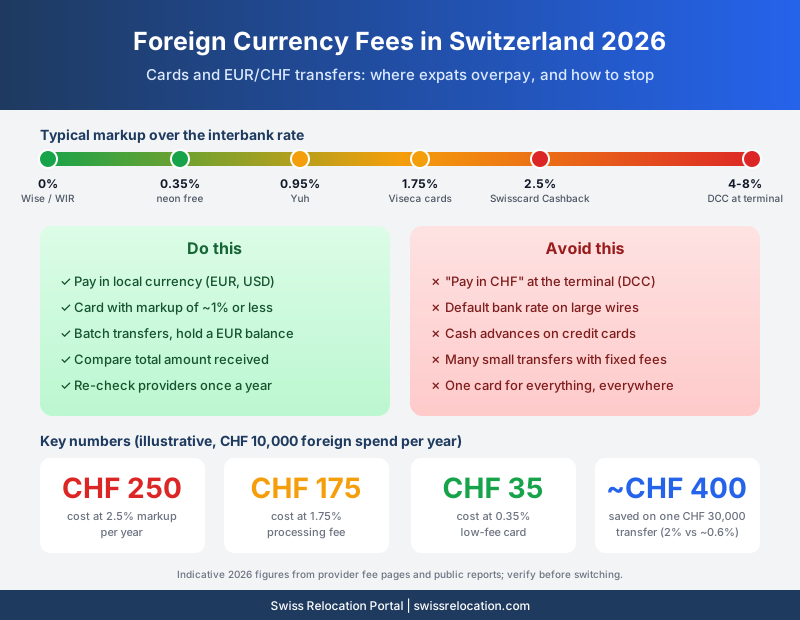
Every currency has a "mid-market" (interbank) rate, the midpoint between buy and sell prices on wholesale markets. Visa and Mastercard use a network rate that is usually within about 0.5% of it. Anything a bank or card issuer adds on top is its margin. A typical traditional Swiss bank markup runs from roughly 1.5% to 2.5% over the interbank rate.
2. Fixed and percentage fees
On top of the markup, some products add a fixed fee per foreign transaction (historically CHF 1.50 or CHF 2.50, now less common on card payments but still found on foreign ATM withdrawals) or a percentage "foreign currency processing fee". For example, Viseca's published fee schedule lists a 1.75% foreign currency processing fee on its Silver, Gold and Platinum credit cards, plus cash withdrawal commissions of 2.5%–4% with minimum amounts.
3. Dynamic currency conversion (DCC)
This is the most expensive trap and the easiest to avoid. When you pay abroad, a terminal or ATM may offer to charge you in your home currency (CHF) "for your convenience". If you accept, the merchant's or ATM operator's own exchange rate is applied, and its markup can reach 4%–8%. The rule is simple: always choose the local currency (EUR in Germany, USD in the US) and let your card network do the conversion.
What Swiss Providers Typically Charge (2026 Snapshot)
The table below combines publicly reported markups for popular products. Rates and conditions change, so use it for orientation rather than as a price list.
| Provider type | Typical markup on foreign payments | Other costs to watch |
|---|---|---|
| Traditional bank credit card (e.g. Swisscard Cashback) | around 2.5% | Annual fee on some tiers; cash withdrawal fees |
| Viseca-issued cards (Silver/Gold/Platinum) | 1.75% processing fee | Annual fee CHF 100–550; 2.5%–4% cash commission |
| Certo! One Mastercard | around 1.5% | Check current conditions |
| Yuh debit card | around 0.95% | Free account tiers have limits |
| neon (free plan) | Mastercard rate + 0.35% | Plus plan reported at CHF 20/year with no markup |
| Revolut | Near interbank on weekdays up to a monthly limit, then about 1%; about 1% on weekends | Plan limits apply |
| Wise card | Interbank rate; about 0.43% fee when converting without a balance in that currency | Holding balances avoids repeat conversions |
| Bank WIR debit card (package) | Interbank rate, no markup | Requires the bank package |
Two takeaways. First, the spread between the best and worst option is roughly 2.5 percentage points. Second, the cheapest products are not exotic: several are ordinary Swiss debit or neo-bank cards that you can order within days. Compare them against your own usage, because limits, plan fees and acceptance (some merchants and car-rental desks require a credit card) matter as much as the headline percentage.
What It Costs You: Worked Examples
Assume exchange-rate effects only, ignoring any annual fee. Costs scale linearly, so double the spend and the cost doubles.
| Annual foreign spend | At 2.5% | At 1.75% | At 0.95% | At 0.35% | At ~0% |
|---|---|---|---|---|---|
| CHF 5,000 | CHF 125 | CHF 88 | CHF 48 | CHF 18 | CHF 0 |
| CHF 10,000 | CHF 250 | CHF 175 | CHF 95 | CHF 35 | CHF 0 |
| CHF 25,000 | CHF 625 | CHF 438 | CHF 238 | CHF 88 | CHF 0 |
Example A: the cross-border household. A couple in Basel spends about CHF 800 a month in Germany and France on groceries, fuel and restaurants, so CHF 9,600 a year. On a 2.5% card that is CHF 240. On a 0.35% card it is CHF 34. That is CHF 206 saved a year without changing behaviour, only the card in the wallet.
Example B: DCC at the till. You pay a EUR 150 hotel bill in Italy. If the terminal converts to CHF and carries a 6% markup over the mid-market rate, you pay about CHF 9 more than necessary on a bill that was already costly. Do it ten times in a year and DCC alone has quietly cost you roughly CHF 90.
Example C: one large transfer. Moving the equivalent of CHF 30,000 to a euro account via a bank that applies a 2% margin costs CHF 600. A specialist provider charging, say, 0.5%–0.7% all-in would cost CHF 150–210. Savings: about CHF 400 on a single transfer. Always compare the total amount the recipient receives, not just the advertised fee.
Sending Money Between Switzerland and Abroad
Bank wire transfers
A SWIFT wire from a traditional Swiss bank can involve a fixed transfer fee, a currency margin, and sometimes intermediary or receiving-bank charges. The margin is the part that is rarely itemised. Ask for the exact rate applied and compare it with the mid-market rate on the day.
SEPA payments in euros
If you hold a euro account in Switzerland (many Swiss banks offer one) you can often send SEPA transfers in EUR to euro-area accounts cheaply or for a small flat fee, because no conversion is involved. This works well when you convert a larger amount once, then pay recurring obligations in euros from that balance.
Specialist money-transfer providers
Services such as Wise and Revolut generally apply a rate close to the mid-market rate and a transparent, usually percentage-based fee. For larger or recurring transfers they are often materially cheaper than a bank. Check three things before you rely on one: the provider's regulatory status and how client money is safeguarded, any transfer limits, and whether the account can receive a Swiss salary or only top-ups.
Timing and transfer size
The CHF/EUR rate fluctuates, but trying to time it rarely pays for ordinary household flows. A more reliable approach is to batch conversions (one larger transfer instead of many small ones with fixed fees) and to convert on a regular schedule so that you average out the rate. If you have a known euro liability, such as a mortgage or tuition, consider keeping a euro balance equal to a few months of payments so a weak franc month does not force a bad conversion.
Building a Low-Cost Currency Setup
You do not need to give up your Swiss bank. A sensible layered structure looks like this:
- Keep your Swiss salary account where it is. It is needed for rent, insurance and Swiss direct debits. If you have not set one up yet, read our guide on opening a bank account in Switzerland as a foreigner.
- Add a low-fee card for foreign spending. A debit or credit card with a markup at or below roughly 1%, used abroad and for foreign online shops. Keep your main Swiss credit card for domestic purchases where its rewards apply.
- Open a euro (or USD/GBP) balance with a provider that lets you hold currency, and top it up in larger, planned conversions rather than per transaction.
- Set recurring transfers for fixed commitments (family support, foreign rent) from that balance on a fixed date each month.
- Review once a year. Fee schedules and plan limits shift. A 15-minute check against your actual statements is enough.
New to the country? Put this on your list during your first month, alongside the items in our First 30 Days in Switzerland checklist.
Cards Abroad: Practical Rules That Save Money
- Always pay in local currency. Decline any "pay in CHF" prompt at a terminal or ATM.
- Avoid ATM cash where possible. Cash advances on credit cards typically carry a percentage commission with a minimum (2.5%–4% in the Viseca schedule above), and many cards start charging interest immediately. If you need cash, use a debit card with a favourable fee structure.
- Do not rely on a single card. Carry a backup from a different network (Visa and Mastercard) in case of blocks or terminal quirks.
- Watch the weekend. Some neo-bank cards apply a higher markup on weekends when markets are closed.
- Check hotel and car-rental holds. Deposits are often charged in the merchant's currency; a low-markup credit card avoids repeated conversion losses.
- Tell your bank when you travel if your issuer is known for aggressive fraud blocks.
Foreign Income, Salary Splits and Tax
If part of your pay is in another currency or you receive foreign income (rent, dividends, freelance work), the conversion rate you use matters for both your bank statement and your tax return. In Switzerland, income in foreign currency is generally declared in CHF converted at the rate set by the cantonal tax authority, often the year-end rate published by the Federal Tax Administration. Always check your canton's guidance and keep records of the rates you used. Expats taxed at source should also review how Quellensteuer works, since an ordinary subsequent assessment can change how foreign income and deductions are treated.
Currency losses on personal conversion are generally not deductible for private individuals, which is another reason to minimise them at the source. For a clearer picture of what your net income really looks like, run your numbers through our Tax Estimator.
Saving for retirement in Switzerland while you hold foreign assets? See how Pillar 3a works for expats and consider the currency exposure of your overall savings, not only your day-to-day spending.
What This Means for You: Practical Checklist
- Pull your last 3 months of card statements and add up every foreign transaction and fee line.
- Calculate your annual foreign spend (cards plus transfers). Multiply by your current markup, using the table above, to see your yearly cost.
- Switch foreign spending to a card with a markup of about 1% or less, if the saving beats any plan fee. Break-even is simple: annual fee ÷ markup difference.
- Turn off DCC mentally. Memorise: local currency, always.
- Request the actual exchange rate from your bank for your next large transfer and compare it with the mid-market rate on the same day.
- Open a currency balance if you have recurring foreign payments or a euro liability.
- Keep documentation of conversion rates for your tax return.
- Set a yearly reminder to re-compare providers.
Frequently Asked Questions
What is a normal foreign currency fee on a Swiss credit card?
Roughly 1.5%–2.5% above the interbank rate is common on traditional bank cards, and Viseca's published schedule lists 1.75% on its standard credit cards. Neo-bank and specialist cards often charge under 1%, and some charge close to nothing on weekday card payments.
Is it cheaper to pay in CHF or in the local currency when abroad?
Local currency, nearly always. Accepting a "pay in CHF" offer at the terminal triggers dynamic currency conversion, where the merchant's or ATM operator's own rate can carry a 4%–8% markup. Your card network's rate is almost always better.
What is the cheapest way to send money from Switzerland to a euro account?
For small, frequent amounts, a specialist provider or a euro balance on a low-fee card account is usually cheapest. For larger one-off sums, compare the total received after fees and rate margin from at least two providers. A euro account at your Swiss bank can also be competitive for SEPA payments if you convert in bulk.
Are Wise and Revolut safe to use as a main account in Switzerland?
They are widely used for currency conversion and travel, but you should check each provider's current regulatory status, how client funds are protected, and whether a given product supports Swiss IBAN features, salary payments and direct debits. Many expats keep a Swiss bank account for core banking and use a second provider purely for foreign-currency needs.
How does the CHF/EUR exchange rate affect my tax return?
Foreign-currency income and assets are declared in CHF at the rate used by your canton, generally year-end or average rates published by the Federal Tax Administration. Check your canton's tax guidance, and consider a professional tax adviser for complex cross-border situations.
Should I convert all my euros at once or gradually?
For known, near-term needs, converting once in a larger batch usually saves on fixed fees. For long-term savings with uncertain timing, spreading conversions over time reduces the risk of picking a bad day. Neither approach beats minimising the markup you pay each time.
Bottom Line
Currency costs are one of the few expat expenses you can cut dramatically in an afternoon, with no change to your lifestyle. Swap one card, learn to refuse DCC, and move recurring transfers off your bank's default rate. For a household with CHF 10,000–25,000 in annual foreign flows, that is typically a few hundred francs a year back in your pocket.
Want to see how much of your income actually reaches your bank account before you start optimising? Try the Swiss Tax Estimator to model your net salary by canton, then use the savings from this guide to top up your Pillar 3a.
Disclaimer: This article is general information, not financial or tax advice. Provider fees and conditions change; verify current terms with each provider and consult a qualified adviser for your situation.
Premium Tool
Calculate Your Swiss Tax Savings
Use our canton-by-canton tax estimator to see exactly how much you'll pay — and how the 2026 reform affects your household.
This portal is built by an expat, for expats. If it saved you time, buy me a coffee.
Buy me a coffee