Pillar 3a for Expats in Switzerland 2026: Retroactive Contributions, Tax Savings & How to Get Started
Pillar 3a for Expats in Switzerland 2026: The Complete Guide to Tax-Free Savings & New Retroactive Rules
If you've been living and working in Switzerland for a year or two and haven't touched Pillar 3a yet, you're almost certainly leaving money on the table — money that's coming straight out of your tax bill. And starting in 2026, there's an entirely new reason to pay attention: for the first time ever, Swiss law now allows you to go back and fill in the years you missed.
This guide covers everything you need to know about Switzerland's private pension system as an expat — from the absolute basics to the brand-new retroactive contribution rules that came into force on 1 January 2026. Tax season in most cantons runs March–April, which means right now is the best possible moment to act.
What Is Pillar 3a, and Why Should Expats Care?
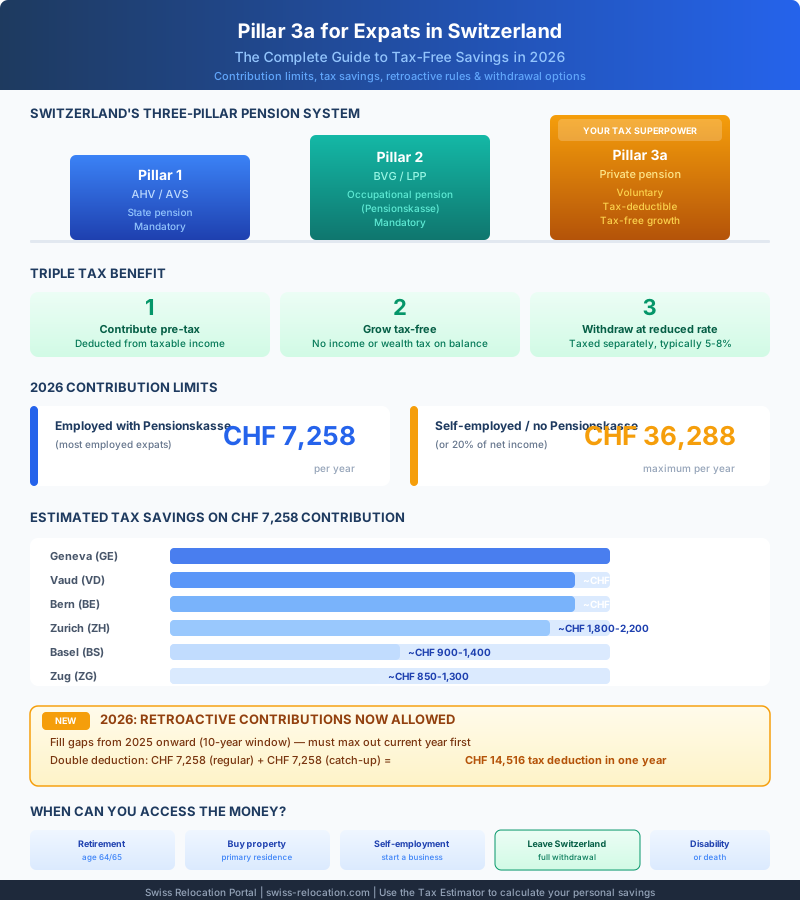
Switzerland's pension system is built on three pillars. The first two — the state pension (AHV/AVS) and the occupational pension fund (BVG/LPP, called "Pensionskasse") — are mandatory and automatic. You pay into them whether you like it or not.
Pillar 3a is different. It's the voluntary, private supplementary pension — and it's one of the most powerful tax tools available to anyone earning money in Switzerland.
Here's why it matters for expats specifically:
You contribute pre-tax money. Every franc you put into a Pillar 3a account is deducted directly from your taxable income. At a marginal tax rate of 35%+, that's a substantial immediate saving.
Your money grows tax-free. While it sits in your account — whether in a savings account or invested in funds — you pay no income tax on interest and no wealth tax on the balance.
You're taxed at a reduced rate when you withdraw. When you eventually take the money out, it's taxed separately from your income and at a reduced rate — typically far below your regular marginal rate.
You don't have to be Swiss. Any person with AHV-liable income in Switzerland qualifies, regardless of nationality or permit type.
Who Qualifies? The AHV Income Rule
The single eligibility requirement for Pillar 3a is simple: you must have earned income subject to Swiss AHV/AVS contributions.
In practice, this covers:
- Employees in Switzerland on B, C, L, or G permits who are paying AHV contributions through their payroll
- Self-employed persons registered with AHV
- People receiving unemployment insurance (ALV) payments
- Cross-border commuters (G-permit holders) who work in Switzerland and pay Swiss AHV
What doesn't qualify: rental income, dividend income, and foreign employment income. The income must be earned through Swiss employment or self-employment.
There is no minimum income threshold and no minimum residency duration. If you started work in Switzerland in October 2025 and are reading this in March 2026, you can already contribute for 2026 — and potentially look at retroactive options for the partial 2025 year.
Not sure which permit you hold or qualify for? Use our Permit Checker to find out.
2026 Contribution Limits
The maximum Pillar 3a contribution for 2026 remains unchanged from 2025:
| Employment Situation | Maximum Annual Contribution (2026) |
|---|---|
| Employed with a Pensionskasse (occupational pension fund) | CHF 7,258 |
| Self-employed without a Pensionskasse | CHF 36,288 (or 20% of net income, whichever is lower) |
| Employed without a Pensionskasse | CHF 36,288 (or 20% of net income, whichever is lower) |
For the vast majority of employed expats working for a company, the relevant figure is CHF 7,258. Most Swiss employers enroll staff in a Pensionskasse automatically, so check your pay slip to confirm.
The amount is the maximum — you can contribute any lower amount and still deduct it in full.
The Big News in 2026: Retroactive Contributions Are Now Allowed
This is the most significant change to Pillar 3a in many years, and it came into effect on 1 January 2026.
Until now, if you missed contributing in a given year — because you were new to Switzerland, had a gap in employment, or simply forgot — that year was lost forever. You couldn't go back and fill the gap.
Starting in 2026, that's changed. You can now make retroactive "buy-in" contributions for years where you had eligible income but didn't contribute (or contributed less than the maximum).
We've written a detailed guide specifically on the retroactive rules — see Pillar 3a Retroactive Contributions in 2026 for the full breakdown.
The Rules for Retroactive Contributions
Before you rush to buy back 10 years of missed contributions, here's what you need to know:
1. Only gaps from 2025 onward count. The retroactive mechanism only applies to contribution years from 2025 forwards. If you didn't contribute in 2022, 2023, or 2024, those gaps cannot be filled under this new rule. The first retroactive payment possible is in 2026, to cover a 2025 gap.
2. You must max out the current year first. Before making any retroactive payment, you must have already contributed the full CHF 7,258 for the current calendar year. Think of it as a pre-condition: fill this year's pot before going back to older ones.
3. You need AHV income in both years. You must have had AHV-liable income in Switzerland in the year you're trying to fill (e.g., 2025) and in the year you're making the payment (e.g., 2026). You also need to be eligible for Pillar 3a in both years.
4. The 10-year window. A gap can be filled up to 10 years after it arises. So a 2025 gap can be bought back at any point until 2035.
5. Exceptions — what you can't retroactively fill. No retroactive payment is allowed for:
- Years spent working abroad (even if temporarily seconded)
- Periods of extended parental leave without AHV-liable income
- Periods of unemployment where ALV did not apply or conditions weren't met
- Years in which you had already received a retirement withdrawal from Pillar 3
6. Age limit. If you are 60 or older, you must not have already received retirement benefits from Pillar 3 to remain eligible for retroactive buy-ins.
Tax Deductibility of Retroactive Payments
Both the regular annual contribution and the retroactive buy-in amount are fully tax-deductible from your cantonal, municipal, and federal income in the year the payment is made.
This is significant. In a high-tax canton like Geneva or Vaud, making a CHF 7,258 retroactive buy-in for a 2025 gap on top of your regular 2026 contribution (another CHF 7,258) means a total deduction of CHF 14,516 in one tax year — which could translate to CHF 3,500–6,000 in actual tax savings, depending on your income and canton.
How Much Can You Actually Save on Taxes?
The answer depends on your canton, municipality, income level, and marital status. Here's a practical breakdown:
| Canton | Max Marginal Rate (2026) | Estimated Annual Saving on CHF 7,258 |
|---|---|---|
| Zurich (ZH) | ~39.7% | ~CHF 1,800–2,200 |
| Geneva (GE) | ~43.3%* | ~CHF 2,000–2,500 |
| Bern (BE) | ~41.1% | ~CHF 1,900–2,300 |
| Vaud (VD) | ~41.5% | ~CHF 1,900–2,300 |
| Basel-Stadt (BS) | ~23.7% | ~CHF 900–1,400 |
| Zug (ZG) | ~22.7%** | ~CHF 850–1,300 |
*Geneva approved a 5–11% income tax reduction for tax year 2025 (filed in 2026). **Zug temporarily lowered its tax coefficient from 82% to 78% for 2026–2029.
As a rule of thumb: for every CHF 1,000 you contribute to Pillar 3a, you save CHF 200–400 in taxes, depending on your situation. At the maximum contribution of CHF 7,258, that's a saving of CHF 1,500–2,500 in a typical year.
Want to see exactly how much you'd save based on your salary and canton? Try the Tax Estimator for a personalised calculation.
Pillar 3a vs. Pillar 3b: What's the Difference?
You might also see references to "Pillar 3b." Here's the short version:
Pillar 3a is "tied" — meaning it has restrictions on when and how you can access the money, but it comes with full tax deductibility and tax-free growth.
Pillar 3b is "free" — it's essentially any other private savings or investment (a regular brokerage account, savings account, or life insurance policy). There are no contribution limits, but the tax benefits are minimal. In most cantons, 3b savings are subject to wealth tax and income tax on returns.
For most expats, Pillar 3a should come first before any 3b contributions.
When Can You Access the Money?
Pillar 3a is a retirement account, but "retirement" is more flexible than you might think. Funds can be withdrawn in these situations:
- Reaching retirement age: Standard Swiss retirement is 64 for women, 65 for men. You can withdraw up to 5 years early (at 59/60) if you've stopped working.
- Buying or renovating your primary residence in Switzerland (Wohneigentumsförderung, WEF).
- Starting or expanding a self-employed business in Switzerland.
- Leaving Switzerland permanently — including moving back to your home country. This is the exit most relevant to expats who don't plan to retire in Switzerland.
- Permanent disability (invalidity).
- Death (paid to heirs or named beneficiaries).
For expats planning to stay in Switzerland for 5–10 years and then return home, the "leaving Switzerland" withdrawal is particularly useful. When you emigrate, you can withdraw your entire Pillar 3a balance and take it with you — taxed at a reduced rate, typically 5–8% of the withdrawal amount depending on your canton.
The Multiple-Account Strategy
Swiss tax law allows you to hold up to 5 Pillar 3a accounts simultaneously (recent legal developments suggest this limit is softening, but 5 remains the practical standard at most providers). Spreading your savings across multiple accounts has one key advantage: staggered withdrawals.
When you eventually withdraw, you pay a lump-sum tax on the amount. By withdrawing from one account in year X and another in year X+2, you avoid having a single large taxable event. Over a multi-account strategy, the tax savings at withdrawal can be substantial.
Example: An expat with CHF 200,000 in a single account withdraws all at once and pays a lump tax of roughly 8% (CHF 16,000). The same expat with CHF 50,000 across 4 accounts, withdrawing one per year over 4 years, may pay only 4–5% per withdrawal (CHF 8,000–10,000 total) — a saving of CHF 6,000–8,000.
Where to Open a Pillar 3a Account
You have two main categories of provider:
Banks and fintechs (3a savings + investment accounts): These are pure savings vehicles. Popular options include VIAC, finpension, Frankly (ZKB), and the major banks (UBS, CS/UBS, PostFinance). Fintech providers like VIAC and finpension offer fully invested portfolios with low fees and have become very popular among expats.
Insurance companies (3a life insurance policies): These combine retirement savings with a life/disability insurance component. Premiums are generally less flexible. Unless you have a specific insurance need, most financial advisors now recommend bank/fintech accounts over tied life insurance policies, due to flexibility and fee transparency.
Practical consideration for expats: Fintechs like VIAC and finpension have English interfaces and are comfortable for international users. Traditional banks may require you to visit a branch and conduct business in German, French, or Italian depending on the canton.
Step-by-Step: How to Make a Retroactive Contribution in 2026
If you had AHV-liable income in Switzerland in 2025 and didn't max out your Pillar 3a, here's what to do:
- Open a Pillar 3a account if you don't already have one (choose a bank or fintech provider).
- Make your full 2026 contribution first — transfer CHF 7,258 for the current tax year.
- Document your 2025 gap — your provider will require proof that you had AHV income in 2025 (pay slips, AHV statement, or employer confirmation).
- Submit the retroactive payment request — not all providers have this process fully automated yet, so check with your provider. Some require a formal written request; others have integrated it into their online platforms.
- Keep the confirmation documents for your tax return. The deduction must appear in the tax year in which the payment is made.
- Declare both amounts separately on your cantonal tax return — regular 2026 contribution and retroactive 2025 payment as separate line items where required.
Need help with tax return preparation? Check out our downloadable document templates for expat-friendly tax guides and checklists.
Frequently Asked Questions
Can I contribute to Pillar 3a if I just arrived in Switzerland and don't have a C permit?
Yes. Any valid work permit — B, L, or G — combined with AHV-liable employment income is sufficient. You can contribute from your very first month of Swiss employment. Nationality and permit type don't matter; it's the AHV income that counts.
What happens to my Pillar 3a if I leave Switzerland?
When you leave Switzerland permanently, you can withdraw your entire Pillar 3a balance. If you're moving to an EU/EFTA country, only the excess above the mandatory BVG minimum may be paid out in cash (the rest goes into a vested benefits account until retirement). If you're moving to a non-EU/EFTA country, the full balance is typically paid out in cash, taxed at the source by your Swiss canton at a reduced withholding rate.
I worked in Switzerland part-time in 2025 — can I still make a retroactive contribution?
Yes, but your retroactive amount is capped at the lower of: (a) the gap between what you contributed and the maximum for that year, and (b) your actual AHV-liable income in that year. So if you earned CHF 5,000 in 2025, your retroactive contribution for 2025 can't exceed CHF 5,000, even though the standard maximum was CHF 7,258.
I'm self-employed without a Pensionskasse — does the same retroactive rule apply?
Yes, the retroactive contribution rule applies to self-employed persons as well. Your gap is measured against the maximum applicable to you (up to CHF 36,288 or 20% of net income), and the same conditions apply: you need AHV income in both years and must max out the current year contribution first.
Is it worth contributing to Pillar 3a if I plan to leave Switzerland in 3 years?
Almost always, yes. The immediate tax deduction (CHF 1,500–2,500 per year in taxes saved) typically outweighs the modest withholding tax on withdrawal when you leave (5–8%). Even over just two or three years, the math usually works in your favor — particularly if you're in a high-tax canton. Run the numbers with your specific marginal rate before deciding.
Key Takeaways
- Pillar 3a is Switzerland's voluntary private pension and the most powerful tax tool available to expats with AHV income.
- The 2026 contribution limit remains CHF 7,258 for employed persons with a Pensionskasse.
- New in 2026: Retroactive contributions are now permitted for gaps from 2025 onward — you have up to 10 years to fill each gap, but must max out the current year first.
- Retroactive buy-ins are fully tax-deductible — in high-tax cantons, filling a missed 2025 year on top of your 2026 contribution means deducting up to CHF 14,516 in one tax year.
- The rule does not apply to gaps caused by periods abroad, parental leave, or unemployment disqualification.
- Use the multiple account strategy (up to 5 accounts) to minimize taxes at withdrawal.
- If you leave Switzerland permanently, you can withdraw the full balance — taxed at a reduced source rate.
Ready to see how much you can save? Use our Tax Estimator to calculate your personal tax savings from Pillar 3a contributions.
Disclaimer: Information in this article is for general guidance only and does not constitute legal, tax, or financial advice. Swiss pension and tax law is complex and varies by canton, income level, and individual circumstances. Please consult a qualified tax advisor or pension specialist before making decisions about your Pillar 3a contributions.
Sources
- VIAC — Pillar 3a maximum contribution 2026
- UBS — Maximum Pillar 3a amount 2026
- UBS — Pillar 3a retroactive contributions
- OBT — Purchases into Pillar 3a from 2026
- Arvy.ch — Pillar 3a Retroactive Contributions: Complete Guide 2026
- Zurich Insurance — Top-up Pillar 3a payments from 2026
- Swiss Life — Making top-up Pillar 3a payments
- Caminada — Retroactive payments into the 3rd pillar possible from 2026
- Taxolution — Pillar 3a guide for expats 2026
- Taxea.ch — Retirement planning for expats: AHV, Pensionskasse, and Pillar 3a
- ch.ch — The 3rd pillar (official Swiss government)
- AXA — Maximum Pillar 3a amount 2026
- Swiss Life — Changes in Switzerland in 2026
Premium Tool
Calculate Your Swiss Tax Savings
Use our canton-by-canton tax estimator to see exactly how much you'll pay — and how the 2026 reform affects your household.
This portal is built by an expat, for expats. If it saved you time, buy me a coffee.
Buy me a coffee