13th Month Salary in Switzerland 2026: Bonus Rules, Pro-Rata Pay and the December Tax Trap for Expats
13th Month Salary in Switzerland 2026: Bonus Rules, Pro-Rata Pay and the December Tax Trap for Expats
If your Swiss contract says "CHF 104,000 per year, paid in 13 instalments", November or December is when the thirteenth one lands. For many expats it is the first time they see it, and it raises the same questions every year. Is it a bonus or part of my salary? Do I still get it if I resign in the spring? Why was so much withholding tax taken off my December payslip? And what happens to the "discretionary" bonus my manager hinted at?
The answers matter in francs. About three quarters of employees in Switzerland receive a 13th salary, according to the Federal Statistical Office's 2024 Earnings Structure Survey (75.9%), while roughly one in three (32.6%) receives a bonus, averaging just under CHF 12,000 a year. Yet Swiss law treats the two very differently. One is wages you have already earned. The other is, in principle, a gift your employer can withhold.
This guide explains the legal difference, how to calculate your pro-rata share when you change jobs, which social-insurance deductions apply, and the withholding-tax effect that surprises people taxed at source in 21 of the 26 cantons. It closes with a checklist you can run against your contract before the December payroll.
What the 13th Month Salary Actually Is
The "13th month salary" (13. Monatslohn, 13e salaire, tredicesima) is not a reward on top of your pay. In most cases it is simply a way of splitting your annual salary into 13 payments instead of 12. Your annual gross is the same either way:
- 13 × CHF 6,000 = CHF 78,000
- 12 × CHF 6,500 = CHF 78,000
That is why the single most important habit when comparing Swiss job offers is to compare annual gross pay, never the monthly figure. A role offering CHF 8,000 × 12 (CHF 96,000) pays less than one offering CHF 7,500 × 13 (CHF 97,500), even though the monthly number looks better.
Is the 13th salary mandatory?
No federal law requires it. The Swiss Code of Obligations (CO) only says that salary is owed; it says nothing about how many instalments. A 13th salary becomes binding when it is:
- written into your individual contract ("annual salary CHF X paid in 13 instalments", or "a 13th month salary is paid"), or
- required by a collective labour agreement (CLA/GAV/CCT) that covers your employer. There were 83 extended CLAs in force in mid-2025, covering roughly 1.1 million workers. Hospitality, construction, staff leasing (temporary work) and many trades include a 13th salary, usually expressed as 8.33% of the annual wage (one twelfth), or
- established by consistent practice, where it has been paid as a fixed amount every year without any reservation.
If none of these applies, there is no 13th salary, and an employer who never promised one owes you nothing extra in December.
13th Salary vs Bonus: The Distinction That Decides Everything
Swiss courts do not care what your payslip calls a payment. They look at whether the amount is determined or determinable in advance.
Contractual 13th salary = wages (Art. 322 CO)
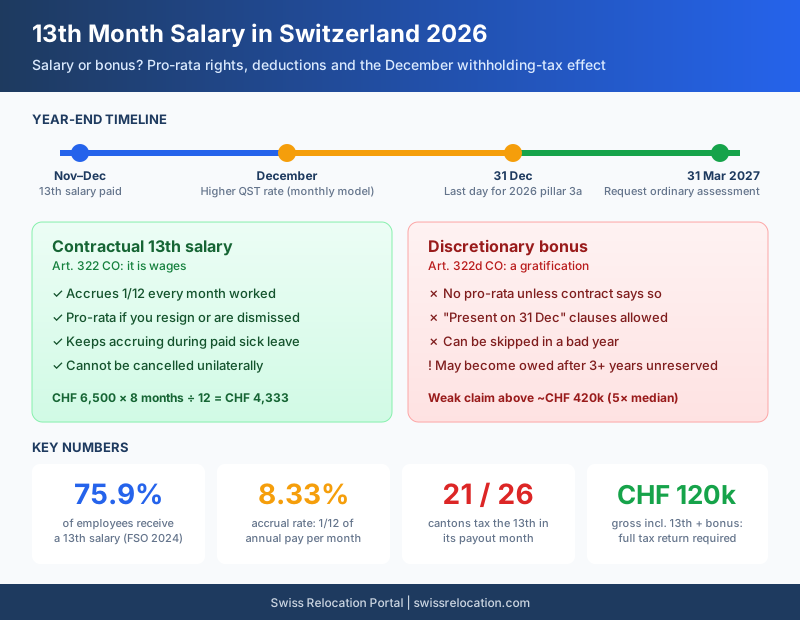
If the amount is fixed or can be calculated by formula (one monthly salary, 8.33% of annual pay), it is salary. That has four consequences:
- It accrues every month you work. You earn one twelfth of it each month.
- You are owed a pro-rata share if you leave mid-year, whether you resign or are dismissed.
- It follows your salary during paid absences. While your employer must keep paying you (illness under Art. 324a CO, daily sickness-benefit insurance, maternity leave), the 13th keeps accruing.
- Your employer cannot cancel it unilaterally. Removing it needs your agreement or a formal "notice of amendment" (Änderungskündigung) that respects your notice period.
Bonus or gratification = discretionary (Art. 322d CO)
A gratification (Gratifikation, gratification) is a special payment granted at the employer's discretion, typically linked to the year's results or your performance, with the amount not fixed in advance. By default:
- No pro-rata on departure. Under Art. 322d para. 2 CO you only get a proportional share if your contract explicitly says so.
- "Must be employed on 31 December" clauses are generally allowed for genuine gratifications.
- The employer can decide not to pay in a bad year, provided it is genuinely discretionary.
When a "discretionary" bonus becomes owed
The Federal Supreme Court has built three safeguards that matter to expats:
- The three-year rule. A bonus paid regularly for at least three consecutive years without an express reservation can become an acquired right through conduct. A real reservation ("voluntary, without legal entitlement, decided anew each year") must be stated each time, and courts can ignore boilerplate that the employer itself contradicts in practice.
- The accessory principle. A gratification must stay secondary to the salary. If a "discretionary" bonus is large relative to base pay and paid regularly, it may be reclassified as variable salary, and then pro-rata and entitlement rules apply.
- The high-earner exception. For very high incomes (case law uses around five times the Swiss median wage, which works out to roughly CHF 420,000 a year), a bonus stays a gratification regardless of its size or regularity. Senior bankers and executives therefore have far weaker bonus claims than mid-level employees.
Comparison at a glance
| Question | Contractual 13th salary | Discretionary bonus (gratification) |
|---|---|---|
| Legal basis | Art. 322 CO (salary) | Art. 322d CO (special payment) |
| Amount | Fixed or calculable (e.g. 1 monthly salary, 8.33%) | Decided by employer each year |
| Accrues monthly? | Yes | No |
| Pro-rata if you resign in June? | Yes, by right | Only if contract says so |
| "Present on 31 Dec" clause valid? | Very doubtful (forfeits earned pay) | Generally valid |
| Can employer skip it in a bad year? | No | Yes, if genuinely discretionary |
| Becomes owed after repeated payment? | Already owed | Possibly after 3+ years without reservation |
| Subject to AHV, ALV, BVG? | Yes | Yes (AHV/ALV); BVG depends on plan |
| Counts for withholding-tax rate? | Yes, in payout month (monthly model) | Yes, in payout month (monthly model) |
Pro-Rata 13th Salary When You Change Jobs
Year-end is peak job-change season. If your contract includes a 13th salary, you are owed a share for the months worked in the current calendar year (or the contract's reference period).
Formula: monthly gross salary × months worked ÷ 12
Worked examples
| Scenario | Monthly salary | Months worked in year | Pro-rata 13th owed |
|---|---|---|---|
| Resign, last day 31 August | CHF 6,500 | 8 | CHF 4,333.35 |
| Start 1 April, still employed in December | CHF 8,000 | 9 | CHF 6,000.00 |
| Leave 31 March after starting 1 January | CHF 9,200 | 3 | CHF 2,300.00 |
| Hourly worker, CHF 30,000 gross earned | n/a | n/a | 8.33% = CHF 2,499.00 |
The pro-rata share is normally paid with your final salary, not in December. If your new employer starts you on 1 April, you will usually receive nine twelfths of your 13th salary in December, so do not expect a full extra month in your first year.
Probation and notice periods
The 13th salary keeps accruing during your notice period, including garden leave. Some CLAs (hospitality is the common example) exclude the pro-rata share if the contract ends during probation, so check yours. Unpaid leave reduces the 13th proportionally; paid holidays do not.
If the employer refuses
Ask for the calculation in writing. If your employer points to a "present on 31 December" clause and you have a salary-type 13th, that clause is legally fragile. Cantonal labour courts (Arbeitsgericht, Prud'hommes) are free of court fees for disputes up to CHF 30,000, which covers almost any pro-rata 13th salary claim. The cantonal labour inspectorate or a union can give a first opinion at little or no cost.
Social Insurance Deductions on the 13th Salary
The 13th salary is part of your AHV-relevant wage, so the same deductions apply as on any other month. For an employee in 2026:
| Deduction | Employee rate 2026 | On a CHF 8,000 13th salary |
|---|---|---|
| AHV/IV/EO | 5.3% (no ceiling) | CHF 424 |
| ALV (unemployment) | 1.1% up to CHF 148,200/year | CHF 88 |
| NBU (non-occupational accident) | Insurer-specific, often around 1% | about CHF 80 |
| BVG (pension fund) | Depends on plan and age | Varies |
Two details trip people up:
- ALV ceiling and high earners. ALV stops once your cumulative annual salary passes CHF 148,200. If your 13th salary or bonus pushes you over the ceiling in December, part of it carries no ALV deduction at all. Check that your payroll applies the cap correctly.
- BVG and the 13th salary. Most pension-fund regulations define insured salary as the annual AHV wage including the 13th. That is good for your retirement capital. It can also tip part-timers over the BVG entry threshold (CHF 22,680 in 2026, CHF 23,040 in 2027): CHF 1,800 × 12 = CHF 21,600 is below it, but CHF 1,800 × 13 = CHF 23,400 is above. Bonuses are often excluded from insured salary; your pension certificate tells you which applies.
Health insurance premiums are not deducted from Swiss salaries; you pay them yourself (see our Swiss health insurance guide). To check your full-year net figure after all payroll deductions and tax, use the Tax Estimator.
The December Withholding-Tax Trap (Quellensteuer)
If you hold a B or L permit and are taxed at source, this is the section that explains your December payslip.
Since the 2021 reform (Federal Tax Administration Circular No. 45), cantons calculate withholding tax in one of two ways:
| Model | Cantons | How the 13th salary and bonuses are treated |
|---|---|---|
| Monthly model | 21 cantons, including Zurich, Zug, Bern, Basel-Stadt, Basel-Landschaft, Lucerne, St. Gallen, Aargau, Schwyz | Added to the wage of the month it is paid. The rate is set on that month's total and applied to the whole month's pay. |
| Annual model | Geneva, Vaud, Fribourg, Valais, Ticino | Added to annual rate-determining income, then spread over 12 months. The rate is adjusted progressively through the year. |
Why December hurts under the monthly model
Swiss withholding tax is progressive. Under the monthly model, a month in which you receive two salaries looks, for rate purposes, like a month in which you earn double. The higher rate then applies to the whole of December's pay, including your regular salary.
Illustrative example (Zurich, single, no children, no church tax): annual salary CHF 104,000 in 13 instalments of CHF 8,000. The rates below are rounded illustrations to show the mechanism, not official tariff values; check your canton's current tariff table for your own figures.
| Monthly model (Zurich) | Annualised equivalent | |
|---|---|---|
| January–November: 11 × CHF 8,000 at about 11% | CHF 9,680 | |
| December: CHF 16,000 at about 19% | CHF 3,040 | |
| Total withheld | about CHF 12,720 | |
| Whole year: CHF 104,000 at an annual-equivalent rate of about 12% | about CHF 12,480 |
In this illustration you overpay a few hundred francs, and there is no automatic year-end correction under the monthly model. A large bonus paid in a single month magnifies the effect considerably: a CHF 30,000 bonus paid in March on top of an CHF 8,000 salary is taxed in March as if you earned CHF 38,000 that month.
How to get the overpayment back
- Earning less than CHF 120,000 a year: you can request a subsequent ordinary assessment (nachträgliche ordentliche Veranlagung, NOV) by 31 March of the following year. You then file a normal tax return and are taxed on your actual annual income, with your real deductions (pillar 3a, pension buy-ins, childcare, commuting). Once requested, you stay in ordinary assessment for future years, so run the numbers first.
- Earning CHF 120,000 or more: ordinary assessment is mandatory, and the withholding tax is credited against your final bill. Remember that the CHF 120,000 threshold counts gross annual pay including the 13th salary and bonuses. A bonus can therefore push you over the line and into a full tax return for that year and beyond.
- Smaller corrections: you can ask the cantonal tax office to correct the withholding (rate, tariff code, children) by 31 March of the following year.
Ask to split the payment
Some employers pay the 13th salary in two halves (June and December) or spread it across 12 months. Under the monthly model, this smooths the rate. Your total gross does not change, but your December tax spike does. It is worth asking HR, especially if you are below CHF 120,000 and do not plan to switch to ordinary assessment.
Cross-border commuters
If you live in France and work in one of the cantons covered by the 1983 Franco-Swiss agreement (Bern, Solothurn, Basel-Stadt, Basel-Landschaft, Vaud, Valais, Neuchâtel, Jura), your salary, including the 13th, is taxed in France on presentation of a residence certificate. Geneva applies withholding tax and compensates France separately. Commuters from Germany, Italy and Austria follow their own treaty rules; your pro-rata 13th and bonus count as regular employment income under all of them.
Bonus Timing, Gifts and Other Year-End Payments
Christmas gifts and vouchers
Small gifts in kind from your employer, such as a hamper or vouchers, are typically free of AHV contributions up to CHF 500 per year and do not need to appear on your salary certificate. Cash, or "gifts" well above that level, are treated as salary and taxed and charged like any other pay. If you receive a large voucher, expect it on your payslip.
Bonus deferrals and clawbacks
In banking, insurance and large corporates, part of a bonus may be deferred over three to five years in shares or cash, with forfeiture if you leave. Read the plan rules before resigning: unvested deferred awards are usually treated as gratifications and are often lost. Some employers will buy out forfeited awards when you join; this should be negotiated before you sign.
Bonuses and permit renewals
For third-country nationals, the cantonal migration office checks that your pay meets local and industry-customary levels. It generally looks at guaranteed pay (base salary plus a contractual 13th). A discretionary bonus normally does not count toward that test. If your employer proposes moving part of your fixed pay into a bonus, check that your guaranteed salary still meets the conditions attached to your permit. Our Permit Checker gives an overview of the permit types and their conditions.
What This Means for You: Practical Checklist
Run through this before the December payroll closes:
- Find the wording in your contract. Look for "13 instalments", "13th salary", "8.33%" or a CLA reference. If it is there, the 13th is salary and you are owed it pro rata.
- Check whether a CLA applies. Ask HR or search your industry's agreement. An extended CLA overrides a less favourable individual contract.
- Read the bonus clause. Is it "discretionary", tied to a formula, or guaranteed? Is there a "present on 31 December" requirement? Has the bonus been paid for three or more years without a written reservation?
- Plan job changes around it. If you are resigning, calculate your pro-rata 13th (monthly salary × months ÷ 12) and confirm it in your exit paperwork. For a bonus, get the current year's treatment agreed in writing.
- Check your December payslip. AHV 5.3% and ALV 1.1% (up to CHF 148,200) should apply to the 13th. ALV should stop once you cross the ceiling.
- If taxed at source in a monthly-model canton, compare December's withholding rate with the rest of the year. Consider asking HR to split future 13th payments.
- Decide on ordinary assessment by 31 March 2027. If you are below CHF 120,000 and have deductions (pillar 3a, pension buy-in, childcare), filing a full return may recover the December overpayment and more. Use the Tax Estimator to compare.
- Use the extra cash deliberately. A pillar 3a contribution before 31 December (up to CHF 7,258 for 2026 if you have a pension fund) reduces taxable income for those in ordinary assessment.
- Keep evidence. Save payslips, bonus letters and emails. They are your proof if a "discretionary" bonus has become an acquired right.
New to Switzerland? Our first 30 days checklist covers payroll set-up, and the cost of living by canton guide helps you judge what your annual package is really worth. For the full relocation picture, see the complete guide to moving to Switzerland.
FAQ
Is the 13th month salary mandatory in Switzerland?
No federal law requires it. It is owed when your individual contract or an applicable collective labour agreement provides for it, or when it has been paid as a fixed amount consistently. About 76% of employees receive one, so it is the norm rather than the exception, but you should always confirm it in writing.
Do I get my 13th salary if I resign before December?
Yes, if it is a contractual 13th salary. You are owed a proportional share: monthly salary × months worked ÷ 12, normally paid with your final salary. A discretionary bonus is different: you only get a share if your contract explicitly provides for it.
Why was my withholding tax so high in December?
In the 21 cantons using the monthly model (including Zurich, Zug, Bern and Basel), the 13th salary is added to December's wage, and the progressive rate for that higher total applies to the whole month's pay. There is no automatic correction. If you earn under CHF 120,000, you can request ordinary assessment by 31 March of the following year to be taxed on your real annual income.
Can my employer cancel my bonus?
If the bonus is genuinely discretionary and the employer has reserved this right, yes. If it has been paid for at least three consecutive years without a real reservation, or if it is large and regular compared with your base salary, courts may treat it as owed. The high-earner exception (roughly five times the median wage) makes this protection much weaker for very high incomes.
Does the 13th salary count toward my pension fund?
Usually yes. Most pension-fund regulations insure the annual AHV wage including the 13th salary. Bonuses are often excluded or only partly insured. Your annual pension certificate shows your insured salary; if the number looks like 12 × your monthly pay, ask your fund why.
I'm on sick leave. Do I still earn my 13th salary?
As long as your employer owes you salary (under the statutory sick-pay scale or through daily sickness-benefit insurance), your 13th salary keeps accruing. It is reduced only for periods without any salary obligation, such as unpaid leave.
Next Step: See Your Real Annual Net
The 13th salary changes when you are paid, not how much you earn, but bonuses, withholding-tax models and the CHF 120,000 threshold can shift your net income by thousands of francs. Enter your annual gross, including the 13th and any expected bonus, in our Swiss Tax Estimator to compare cantons, check whether ordinary assessment would save you money, and plan your year-end 3a contribution before 31 December.
This article provides general information and is not legal or tax advice. Employment terms depend on your contract and any applicable collective labour agreement; for a specific dispute, contact your cantonal labour inspectorate, a union or an employment lawyer.
Premium Tool
Calculate Your Swiss Tax Savings
Use our canton-by-canton tax estimator to see exactly how much you'll pay — and how the 2026 reform affects your household.
This portal is built by an expat, for expats. If it saved you time, buy me a coffee.
Buy me a coffee