Swiss Ski Season 2026/27: Season Pass or Day Tickets? The Expat Cost Guide
Swiss Ski Season 2026/27: Season Pass or Day Tickets? The Expat Cost Guide
Almost every expat who moves to Switzerland says the same thing in the first autumn: "We have to ski this winter." Then the first lift-ticket price appears on a screen and the enthusiasm gets a reality check. A single adult day ticket in a big resort can cost close to CHF 90, and a family of four can spend CHF 300 or more on lift access alone before anyone has put on a boot.
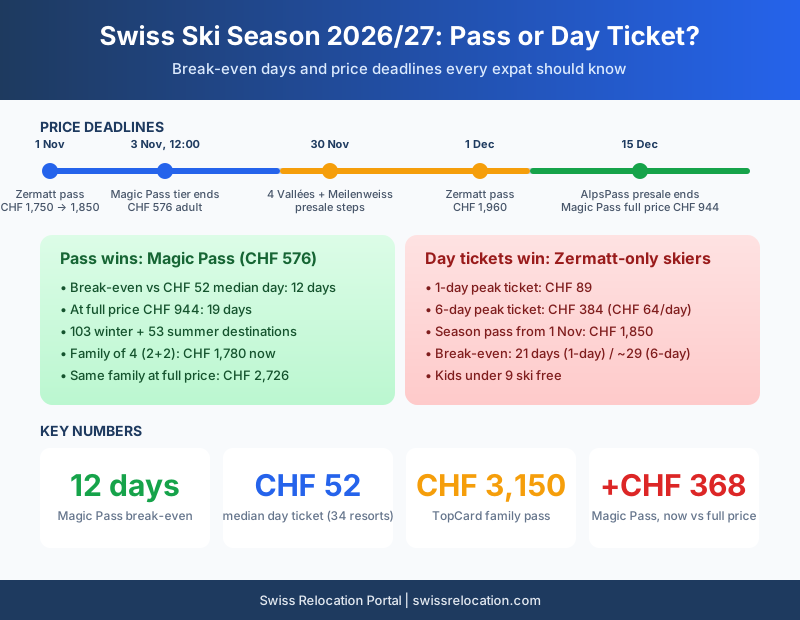
The good news is that Switzerland also has some of the most competitive season passes in the Alps, and the prices are staggered by purchase date. That staggering matters right now. The current Magic Pass price tier is guaranteed only until 3 November 2026 at 12:00, and the Zermatt season pass price rises on 1 November and again on 1 December. If you are going to buy a pass, the cheapest window is closing within days.
This guide compares the main options for the 2026/27 season using published prices, calculates break-even days for different kinds of skiers, and shows what a realistic winter budget looks like for a single person, a couple and a family with two children.
All prices below come from the providers' published 2026/27 price lists as of 29 October 2026. Stage-based prices change on fixed dates, so always confirm on the provider's own page before you pay.
The Short Version
- Skiing 12 days or more on mid-sized resorts? A Magic Pass at today's CHF 576 beats day tickets at the median day price of roughly CHF 52.
- Skiing mostly in Zermatt, Verbier or the big Graubünden areas? The maths changes completely. A season pass only pays off after about 20 ski days at Zermatt's day-ticket price, so for many people multi-day tickets are cheaper.
- Family with children? Child prices are where season passes shine. Magic Pass children's rates and the TopCard family pass can turn a CHF 300-a-day habit into a flat cost.
- Not sure how often you will go? Do not buy the most expensive pass in November on enthusiasm alone. Buy a few day tickets in December, then decide.
Why Ski Pricing in Switzerland Feels Confusing
Swiss resorts price lift access in three overlapping ways, and understanding the difference saves real money.
Day and multi-day tickets are priced per date. Resorts use dynamic or tiered calendars, so the same ticket is cheaper in early season and more expensive during Christmas and February holidays. Zermatt, for example, charges the same peak price for a one-day ticket as for a basic-season day, but multi-day tickets get cheaper per day the longer you stay.
Regional or resort-group passes such as the TopCard (Laax, Arosa Lenzerheide, Davos Klosters) or the Meilenweiss annual pass cover a defined set of mountains for the whole winter.
Network passes such as the Magic Pass give you access to a very large number of resorts, but typically not the biggest, most expensive names.
The second thing that confuses newcomers is presale pricing. Many passes launch in spring at a low price and rise in stages until December. Buying late is the single most expensive mistake you can make.
2026/27 Season Pass Prices at a Glance
The table below shows the headline adult price and the most relevant discounted categories. "Current" means the price level valid at the time of writing.
| Pass | Adult | Youth / teen | Child | Coverage | Key date |
|---|---|---|---|---|---|
| Magic Pass | CHF 576 (current), CHF 944 (regular) | n/a (children's rate for 2011–2020 births) | CHF 314 (current), CHF 419 (regular) | 100+ winter areas | Price guaranteed until 3 Nov 2026, 12:00 |
| AlpsPass | CHF 949 (presale), CHF 1,249 (regular) | CHF 299 / 499 | CHF 199 / 399 | 11+ areas | Presale to 15 Dec 2026 |
| Meilenweiss | CHF 1,150 (presale), CHF 1,200 (regular) | CHF 925 / 965 | CHF 575 / 595 | 17+ areas | Presale 1 Oct–30 Nov 2026 |
| Central Switzerland Snow Pass | CHF 1,195 | CHF 835 | CHF 535 | 15+ areas | No deadline listed |
| TopCard Graubünden | CHF 1,550 | CHF 1,035 | CHF 545 | Laax, Arosa Lenzerheide, Davos Klosters | Family pass CHF 3,150 |
| 4 Vallées (Verbier) | CHF 1,349 (to 30 Nov), CHF 1,499 (regular) | CHF 500 / 600 | CHF 400 / 500 | Verbier, Nendaz, Veysonnaz, Thyon, La Tzoumaz | Price steps 30 Nov |
| Zermatt Season Pass (Switzerland only) | CHF 1,750 (to 31 Oct), CHF 1,850 (from 1 Nov), CHF 1,960 (from 1 Dec) | CHF 1,488 / 1,666 | CHF 875 / 980 | Zermatt | Rises 1 Nov and 1 Dec |
| Zermatt–Cervinia International | CHF 1,850 (from 1 Oct), CHF 1,960 (from 1 Nov), CHF 2,070 (from 1 Dec) | about CHF 1,573–1,760 | CHF 925 / 1,035 | Zermatt and Cervinia (Italy) | Rises 1 Nov and 1 Dec |
| Graubünden Pass | CHF 1,785 (presale), CHF 2,247 (regular) | CHF 1,190 / 1,498 | CHF 595 / 749 | 40+ areas | Presale ended 30 Apr 2026 |
Two observations stand out. First, the Magic Pass is in a different price universe from everything else, even at today's mid-stage price. Second, the child categories matter more than the adult price when you do the family maths.
Heads-up on conflicting numbers: Magic Pass's own pages show both launch-stage prices (adult CHF 419, child CHF 282) and the current tier (adult CHF 576, child CHF 314). The launch prices were available from 10 March 2026 and are long gone. The current tier is the one that expires on 3 November.
What a Day Ticket Actually Costs
For a fair comparison you need realistic day-ticket numbers. Zermatt publishes starting prices for winter 2026/27 that illustrate how steep the curve is:
| Days | Peak season (adult) | Basic season (adult) | Pre-season (adult) |
|---|---|---|---|
| 1 day | CHF 89 | CHF 89 | CHF 100 |
| 2 days | CHF 148 | CHF 168 | CHF 188 |
| 3 days | CHF 209 | CHF 237 | CHF 265 |
| 6 days | CHF 384 | CHF 436 | CHF 488 |
Peak season runs 19 Dec–3 Jan, 25 Jan–7 Mar and 27 Mar–18 Apr 2027. Children aged 9–15 get 50% off, and children under 9 ski free. On Saturdays, Zermatt lift tickets for children up to 15 are free.
The pattern is clear: a six-day ticket in peak season works out to CHF 64 per day, a third cheaper than six single days. For visitors and occasional skiers, the multi-day ticket is the main money-saver.
For comparison, an independent analysis of 34 Magic Pass resorts found a median adult day ticket of CHF 52 (mean CHF 54.56) at in-network areas, versus a median of about CHF 60 outside the network. The most expensive resort in that Magic Pass dataset, Saas-Fee, was listed at CHF 87.
Break-Even Maths: How Many Ski Days Justify a Pass?
Break-even days are simply the pass price divided by the day-ticket price you would otherwise pay, rounded up. Here is what that looks like.
| Scenario | Pass price | Day-ticket price | Break-even |
|---|---|---|---|
| Magic Pass, current price | CHF 576 | CHF 52 (median) | 12 days |
| Magic Pass, regular price (mid-December) | CHF 944 | CHF 52 | 19 days |
| Magic Pass child, current price | CHF 314 | roughly CHF 26–30 (about half-price kid tickets) | roughly 11–12 days |
| TopCard Graubünden adult | CHF 1,550 | about CHF 90 (illustrative big-resort day) | roughly 17 days |
| Zermatt Season Pass (to 31 Oct) | CHF 1,750 | CHF 89 (peak 1-day) | 20 days |
| Zermatt Season Pass (from 1 Nov) | CHF 1,850 | CHF 89 | 21 days |
| Zermatt Season Pass (from 1 Nov) vs 6-day tickets | CHF 1,850 | about CHF 64 per day (6-day peak) | about 29 days |
The TopCard day-ticket figure is an illustrative assumption for comparison, not a published price, so treat that row as a rough guide.
The insight most people miss is the last row. If you actually ski in blocks of six days, a Zermatt season pass needs closer to 29 ski days to break even, which is more than most expat households will manage in a winter that also includes work, school and sick days.
A realistic number of ski days
Most people who say "we will ski every weekend" ski 8–15 days in their first winter. Between work, weather, school holidays that clash with peak pricing, and the occasional cold, 10–12 days is a sensible planning assumption for a motivated household. That is why the Magic Pass works for so many newcomers: its break-even sits right at the edge of what a keen beginner will use.
Three Household Scenarios
Scenario 1: Single professional, 10 ski days
You have a demanding job, you ski mainly on weekends, and you are happy to travel to mid-sized resorts.
- Day tickets at CHF 52 median: 10 × 52 = CHF 520
- Magic Pass at today's CHF 576: CHF 576 (more than day tickets at 10 days, but includes a summer season and unlimited extra days)
- Magic Pass if you had bought at the lowest stage (CHF 419): CHF 419
At exactly 10 days, a pass at the current tier and day tickets cost about the same. The tipping point is 12 days. If you think you will go more than 12 times, buy before 3 November. If you are unsure, buying day tickets for the first few weekends is a legitimate strategy, because the price only rises from here.
Scenario 2: Couple, 15 ski days each
- Day tickets, 2 × 15 × CHF 52: CHF 1,560
- Two Magic Passes at CHF 576: CHF 1,152, saving around CHF 408
- Two Magic Passes at the regular price (CHF 944): CHF 1,888, which is more than day tickets
For couples who ski regularly, the saving is meaningful, but it disappears entirely if you wait until mid-December to buy.
Scenario 3: Family of four (two adults, two children aged 9–15), 12 ski days
This is where the choice of pass structure matters most.
- Magic Pass, current tiers: 2 × CHF 576 + 2 × CHF 314 = CHF 1,780
- Magic Pass, regular tiers: 2 × CHF 944 + 2 × CHF 419 = CHF 2,726
- Day tickets, mid-size resorts: 12 days × (2 × CHF 52 + 2 × about CHF 26) ≈ CHF 1,872
- TopCard family pass (Davos, Laax, Arosa Lenzerheide): CHF 3,150, covering a family with children up to 17, with an extra CHF 325 for each young adult aged 18–35
For this family, day tickets at 12 days (about CHF 1,872) and the current Magic Pass (CHF 1,780) are nearly identical. The Magic Pass wins if the family skis more than 12 days or wants the summer-season benefits. The TopCard family pass only makes financial sense if the family is committed to the three Graubünden areas it covers and will ski far more than 12 days.
What Else Does a Ski Day Cost?
Lift access is only one line item. For a realistic budget, add the following. These are typical ranges based on common Swiss market levels rather than quotes from a single provider, so check your own resort.
- Equipment rental: roughly CHF 40–70 per day for adults for skis, boots and poles, usually less for children. Buying second-hand gear through local swap markets and Swiss classifieds can pay off within a single season.
- Ski school or private lessons: group lessons for children typically cost CHF 60–120 per half-day, and private lessons for adults are significantly more.
- Food: mountain restaurant lunches commonly run CHF 25–40 per person. A packed lunch saves a family of four roughly CHF 100 per day.
- Transport: train travel to the mountains is often cheaper and easier than driving. If you travel by rail a lot, our guide to the cost of living in Switzerland by canton shows how transport costs vary around the country.
- Parking and winter equipment: if you drive, you need winter tyres and snow chains, and some resorts charge for parking.
A realistic all-in day for two adults and two children, using day tickets, rental, lunch and transport, can easily reach CHF 500–700. This is why season passes and packed lunches become attractive very quickly.
Insurance and Safety: Do Not Skip This
Ski injuries are common, and rescue and treatment in the Alps can be expensive. Before your first day on the slopes, check three things.
- Your basic health insurance covers medically necessary treatment, but the deductible and 10% co-payment still apply. Our Swiss health insurance guide explains how deductibles work and why a higher deductible can backfire in a ski year.
- Accident cover: employees working eight or more hours per week are covered for accidents through their employer's accident insurance, but self-employed people and non-working family members usually need to include accident cover in their basic health policy.
- Mountain rescue and repatriation: helicopter rescue is generally not fully covered by basic insurance. Check whether a rescue membership or supplementary policy makes sense for your household before the season starts.
Smart Ways to Cut Your Ski Costs
Buy early, not late. Presale pricing is the largest saving in Swiss skiing. The Magic Pass price difference between the March launch and the December regular price is more than CHF 500 for an adult.
Use the shoulder season. Pre-season and early-December basic pricing is lower than peak. Zermatt's basic-season single-day price equals its peak price, but multi-day tickets in peak weeks cost less per day than in the basic window, so check the full table before booking.
Choose weekdays. If your working arrangement allows it, mid-week skiing means shorter queues, fewer crowds and sometimes cheaper tickets.
Check employer benefits. Some Swiss employers subsidise or offer discounted passes, and some health insurers offer wellness refunds. Ask HR before you buy.
Combine rail and lift tickets. Joint rail-and-lift offers are common and often cheaper than buying them separately. Look for current winter combination offers on the Swiss rail website or the resort's own site.
Do not forget the summer. Many season passes include summer lifts, which adds value if you hike. The Magic Pass covers 53 summer destinations, which changes the break-even calculation if you will use it in July.
What This Means for You: A Practical Checklist
- Count your realistic ski days. Be honest: 8, 12 or 20? Use 10–12 as the default for a first-year household.
- Decide on location. Are you happy at mid-sized resorts, or do you only want Zermatt or Verbier? Network passes and resort passes serve very different goals.
- Run the break-even maths. Divide the pass price by CHF 52 for network resorts or by the actual day-ticket price at your target resort.
- Check the deadlines: Magic Pass tier ends 3 Nov at 12:00, Zermatt prices rise 1 Nov and 1 Dec, 4 Vallées steps on 30 Nov, Meilenweiss presale ends 30 Nov, AlpsPass presale ends 15 Dec.
- Add rental, lessons, food and insurance to a full-season budget before you commit.
- Confirm accident and rescue cover before the first day.
- Keep your receipts. Some employers and insurers reimburse part of sports memberships, and keeping documents makes it easy to claim.
- Plan your budget against your net income. Use the Tax Estimator to see what your take-home pay looks like in your canton, then set a realistic leisure budget.
- If you are still waiting on a residence permit, check your status with the Permit Checker before booking non-refundable winter travel.
Frequently Asked Questions
Is the Magic Pass worth it for a newcomer?
For most households that expect to ski at least 12 days at mid-sized resorts, yes, at today's CHF 576 adult price. It is not worth it if you only plan to ski in Zermatt, Verbier or Davos, because those areas are not part of the main network and you would pay day-ticket prices there anyway. Independent analysis shows only two of Switzerland's largest ski areas are in the network.
What happens if I miss the 3 November deadline?
The price rises in stages until it reaches the regular rate of CHF 944 for an adult and CHF 419 for a child in mid-December. At the regular price, the break-even climbs to about 19 ski days, so many casual skiers will be better off with day tickets.
Do children really ski for free in Switzerland?
It depends on the resort. In Zermatt, children under 9 ski free, children aged 9–15 get 50% off, and children up to 15 ski free on Saturdays. Other resorts have different age limits and conditions, so check each resort's family policy.
Can I buy a ski pass without a residence permit or Swiss address?
Yes. Ski passes are consumer products and do not require a Swiss residence permit. You will need a photo for most season passes, and some providers require a Swiss or EU billing address for certain family discounts, so check the provider's terms.
Is a family pass better than individual passes?
Only if the family fits the pass's structure. The TopCard family pass at CHF 3,150 covers children up to 17 and makes sense for a family that skis intensively in the three Graubünden areas it covers. A household that skis 10–12 days across several regions will usually save more with individual Magic Pass tickets or day tickets.
Is ski insurance included in a season pass?
Usually not. Season passes give you lift access. Accident cover, mountain rescue and liability are separate, so confirm your own insurance before the first day.
Bottom Line
The cheapest way to ski in Switzerland in 2026/27 is to decide early, buy at the right price stage, and match the pass to your real habits instead of your best intentions. For a keen but realistic household, the Magic Pass at today's price is the strongest value in the country. For a Zermatt devotee, a multi-day ticket is usually cheaper than a season pass unless you ski nearly thirty days. And for everyone, the deadline calendar matters as much as the price.
Before you commit hundreds or thousands of francs to a winter hobby, check how it fits your overall budget. Our Tax Estimator shows your estimated take-home pay by canton, so you can plan your winter spending with confidence.
Calculate your Swiss take-home pay with the Tax Estimator →
Sources: Magic Pass pricing page; Empire of the Style 2026/27 ski pass comparison; Zermatt Matterhorn Paradise starting prices winter 2026/27; Davos Klosters ticket and TopCard price pages; deinskigebiet.ch Magic Pass break-even analysis. Prices are subject to change; confirm with each provider before purchasing. This article is general information, not financial or insurance advice.
Premium Downloads
Get the Complete Relocation Checklist
Download our step-by-step PDF guides covering banking, insurance, housing, and everything you need for your Swiss move.
This portal is built by an expat, for expats. If it saved you time, buy me a coffee.
Buy me a coffee