TWINT, Cards or Cash? How to Pay in Switzerland as an Expat in 2026 (and What Changes in 2027–2028)
TWINT, Cards or Cash? How to Pay in Switzerland as an Expat in 2026 (and What Changes in 2027–2028)
You land in Zurich, buy a coffee, and the person behind you pays by holding a phone against a small QR sticker. At the farmers' market, the stall owner points to a TWINT code. Your landlord asks for a Swiss IBAN. Your health insurer wants a direct debit. Within the first week, it becomes clear that money in Switzerland moves differently than it does in the US, the UK or most of the EU.
The good news: you can get by with a decent card and a Swiss bank account. The better news: setting things up properly in the first weeks saves real money, especially on currency conversion and card fees. And in the next two years the system itself is changing. TWINT, the Swiss mobile payment app, is about to take over recurring bills, and the old LSV+ direct debit that many households rely on is being switched off on 30 September 2028.
This guide explains how everyday payments work in Switzerland in October 2026, what is realistic for newcomers (including cross-border commuters who live abroad), what each option costs, and what to do before the 2027–2028 changes arrive.
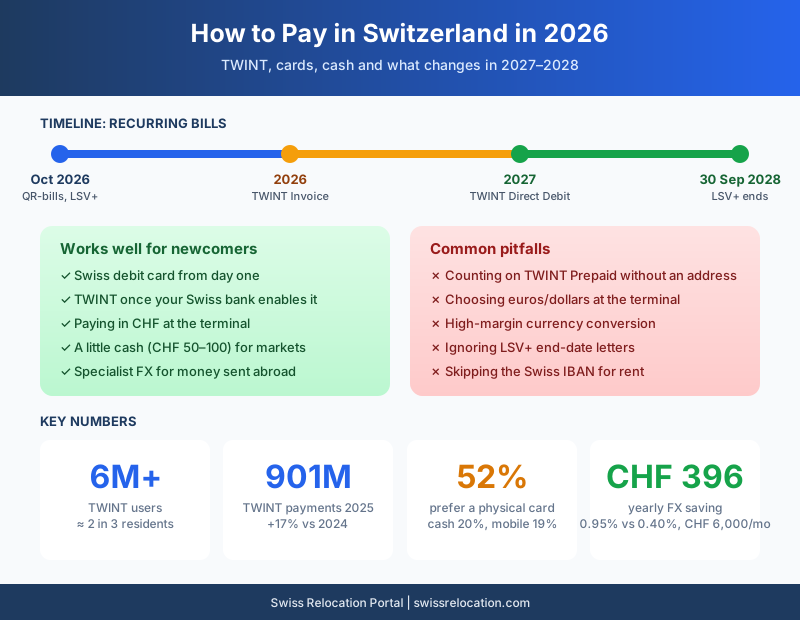
The Short Version
- TWINT is used by more than 6 million people, which is roughly two in three Swiss residents, and handled about 901 million transactions in 2025 (+17% on 2024). It is accepted at roughly 81% of physical stores and 86% of online shops.
- Cards are still king in shops. In a March 2026 survey of credit card users, 52% named a physical card as their preferred way to pay in-store, 20% cash and 19% mobile payment (up from 8% in 2022).
- TWINT needs a Swiss-linked account. Without a Swiss address, access has become harder. Several neo-banks only serve people resident in Switzerland.
- Recurring bills are changing. TWINT Direct Debit is planned for 2027, and the LSV+ direct debit system ends on 30 September 2028.
- Foreign-currency fees are the hidden cost. On a CHF 6,000 monthly salary, the difference between a 0.95% and a 0.40% conversion margin is roughly CHF 400 per year.
How Switzerland Pays in 2026
Why a cashless country still has cash
Switzerland has a reputation for being cash-friendly, and the numbers explain why. According to the bonus.ch survey published in March 2026 (2,000+ respondents, all credit card users), 20% still prefer cash for in-store purchases. Among over-60s that rises to 24%; among 40–49 year-olds it drops to just 9%.
The language region matters. In German-speaking Switzerland, 23% prefer cash (down from 26% a year earlier) while 17% prefer mobile payment (up from 12%). In the French-speaking part, mobile payment has caught up with cash. In Ticino, nearly 30% prefer mobile payment, the highest share in the country. If you move from Lugano to Lucerne, expect different habits.
For you, the practical conclusion is simple: carry a card, install TWINT if you can, and keep a little cash (CHF 50–100) for markets, small village restaurants, laundry rooms, ski-lift kiosks and the occasional place that is "card only above CHF 20".
Why TWINT won
TWINT started in 2017 with about 4 million transactions in its first year, passed 100 million in 2020 and reached 901 million in 2025. Around 77% of those payments are commercial, 23% are person-to-person (splitting a restaurant bill, paying the babysitter, sending the flat-share rent). About 65% of commercial payments happen on site, 35% online.
The reasons it works in Switzerland are boring but decisive. It is tied to your Swiss bank account (so there is no "top-up" friction), it is accepted from the bakery to the parking meter, and it is the default way to pay a friend. Over 70 Swiss banks let customers use it.
Option 1: A Swiss Bank Account (Your Foundation)
Almost everything else (TWINT, direct debits, rent, salary) hangs on a Swiss IBAN. If you have not opened one yet, start with our complete guide to opening a bank account in Switzerland as a foreigner and the First 30 Days checklist.
What to look for from a payments point of view:
- A Swiss IBAN in CHF for your salary, rent and insurance.
- A debit card (Debit Mastercard or Visa Debit in most cases). Check the fee per foreign-currency transaction if you travel.
- TWINT compatibility. Most major banks support it. Confirm that your specific account type does.
- A clear price list for account maintenance, card fees and cash withdrawals.
Typical position for a newcomer: a mainstream bank or PostFinance for the salary account, and optionally a neo-bank for low-cost currency exchange and travel.
Option 2: TWINT
What you need
To use TWINT you generally need:
- A smartphone with a Swiss-compatible setup (iOS or Android)
- A Swiss mobile number is the normal route; check the current onboarding terms of your bank
- A Swiss bank account or card from a participating issuer
- Identity verification, usually done in the app or through your bank
Your bank may offer its own TWINT-enabled app or a link inside its e-banking app. Treat the details as bank-specific and confirm them when you open the account.
TWINT without a Swiss address (cross-border commuters)
This is where newcomers get stuck. A 2026 guide by the currency specialist ibani reports that TWINT Prepaid no longer works without a Swiss address (observed in late 2025), and that the realistic route is a Swiss neo-bank that accepts your country of residence and offers TWINT access. A few findings from that guide (September 2026):
- Yuh accepts residents of Switzerland, Austria and Liechtenstein only; account openings for other countries are on hold.
- Neon and Zak require a residential address in Switzerland.
- Yapeal is often mentioned as open to cross-border workers, but you must confirm eligibility and TWINT compatibility yourself.
Because ibani sells currency exchange, treat its comparison as one input and check each provider directly. The rule of thumb for Grenzgänger (cross-border commuters): do not count on TWINT being available on day one. Get a debit card working first, and treat TWINT as a bonus. If you are in this situation, use the permit checker to confirm which permit applies to you.
What TWINT is good for
- Shops, restaurants and kiosks with the TWINT QR code or terminal
- Vending machines, parking, public transport tickets in many cantons
- Paying friends instantly (split the bill, pay back a loan)
- Online shopping in Swiss webshops (86% accept it)
- Loyalty cards and vouchers inside the app
What TWINT is not good for (yet)
- Paying abroad (it is a domestic system)
- Setting up recurring bills. That changes in 2027, see below.
Option 3: Debit and Credit Cards
For shop payments, the physical card remains the most popular choice (52% in the 2026 survey). Things to know:
- Contactless is standard; small payments need no PIN, larger ones do.
- Swiss debit cards are linked directly to your CHF account, which makes budgeting easy and avoids interest.
- Foreign cards work almost everywhere, but charges add up: a foreign-currency or dynamic currency conversion fee, plus potentially an ATM fee.
- Credit cards can be useful for car rentals, hotels and online subscriptions, but check the annual fee. Some Swiss providers waive it for the first year.
Always choose to pay in Swiss francs when the terminal asks, not in your home currency. The "convenience" conversion usually carries a worse rate.
Option 4: Cash
Cash is still legal tender, widely used and often the most practical option in specific situations: some farm shops, flea markets, tips, kids' pocket money, the school bake sale, small club memberships. The ATM network is dense; withdrawing at your own bank's machines is typically cheapest.
What Does It Really Cost? A Worked Example
Imagine you are a cross-border commuter or an expat who gets a CHF 6,000 net monthly salary, and you convert it to euros at the end of each month for a household abroad.
| Conversion route | Margin | Cost per month | Cost per year |
|---|---|---|---|
| Neo-bank (example: Yuh, per ibani) | 0.95% | CHF 57 | CHF 684 |
| Specialist exchange provider, amounts under CHF 10,000 (example: ibani) | 0.40% | CHF 24 | CHF 288 |
| Large amounts via specialist (above CHF 10,000) | down to 0.15% | CHF 9 | CHF 108 |
The numbers for Yuh and ibani come from ibani's own comparison and should be verified, but the order of magnitude is the point: CHF 396 per year separates the first two lines on this salary. For higher incomes or bonuses, the gap multiplies. For expats whose life stays in Switzerland, none of this applies; but if you send money home regularly, check the margin before you choose a bank. For a broader view of monthly spending, see How much money do you really need to live in Switzerland in 2026 and cost of living by canton.
The Quiet Change: How Recurring Bills Will Work
Most expats run into this within a month. Your health insurer, landlord, mobile provider and electricity company all need to be paid regularly. Today, there are three common ways:
- QR-bill by e-banking or mobile banking. You receive an invoice with a QR code, scan it in your banking app and approve.
- Standing order. Fixed amount, fixed date, set up in e-banking (typical for rent).
- Direct debit (LSV+ or the bank's own direct debit). The biller pulls the money; you authorise it with your bank.
What is changing
Two announcements matter for the next 24 months:
- TWINT Direct Debit, planned for 2027. TWINT has said it will introduce recurring direct debits in 2027 so that users can set up recurring payments directly in the app, for items such as health insurance premiums, energy bills and subscriptions. Swiss banks have said they will support it. The exact launch month and fees have not been published.
- LSV+ ends on 30 September 2028. The direct debit scheme it replaces will be discontinued, and TWINT Direct Debit is designed as part of its successor landscape. If you currently authorise bills through LSV+, your biller will tell you what to do. Do not panic, but do not ignore the letters.
TWINT also plans TWINT Invoice as a paperless alternative to QR-bills.
What this means for you
If you arrive now, you will probably start with QR-bills and a standing order for rent, then be offered TWINT-based options as your insurers and utilities switch. Keep an eye out for notifications from your health insurer in particular. If you changed your plan in the open enrolment window (notice to your current insurer must reach them by 30 November; see our Swiss health insurance guide), check how your new insurer wants to collect premiums.
Common Mistakes Newcomers Make
- Waiting for TWINT before buying anything. Use your card in week one.
- Paying in euros or dollars at the terminal. Always select CHF.
- Using a foreign credit card for everything. Conversion and cash-advance fees quietly accumulate.
- Forgetting the rent deposit and first-month payments. Landlords expect a Swiss IBAN. A foreign account makes the process slower.
- Ignoring QR-bill deadlines. A late payment can trigger reminder fees. Add due dates to your calendar or use e-banking reminders.
- Not keeping some cash. Markets, kiosks and kids' events still love coins.
Practical Checklist
Before you arrive
- Order a Swiss-compatible debit or travel card if your home bank offers one with low foreign fees.
- Gather documents for a Swiss bank account: passport, permit (or proof of the pending application), employment contract, proof of address.
In the first two weeks
- Open your Swiss bank account and request a debit card.
- Ask if your account is TWINT-compatible and set it up.
- Register your Swiss mobile number with your bank for authentication.
- Set up e-banking and the banking app. Test a QR-bill payment with a small amount.
In the first two months
- Add standing orders for rent and fixed bills.
- Compare currency exchange margins if you send money abroad.
- Check when your health insurer's 2027 notice arrives and decide whether to switch (deadline 30 November).
Through 2027–2028
- Watch for TWINT Direct Debit announcements from your biller and bank.
- If you have LSV+ authorisations, note the 30 September 2028 end date and replace them before it arrives.
Frequently Asked Questions
Can I use TWINT as soon as I arrive in Switzerland?
Usually not on day one. You typically need a Swiss bank account or compatible card and a way to verify yourself. Plan on one to three weeks after your arrival, depending on how quickly your bank opens the account.
Can cross-border commuters use TWINT?
It is possible but not guaranteed. Reports from 2026 suggest TWINT Prepaid no longer works without a Swiss address, and some neo-banks have paused openings for non-residents. Check with your bank whether your specific account type works with TWINT. Meanwhile, a debit card handles most shop payments.
Is TWINT free?
For private users, using the app to pay is generally free of charge, though your bank may charge for the underlying account. Merchants pay fees, which is one reason some small shops still prefer cash. Check your bank's price list for details.
Do I need cash in Switzerland?
Not much, but a small reserve is wise. In the March 2026 survey, 20% of respondents still preferred cash for in-store purchases, and the share is higher in German-speaking Switzerland and among older customers.
What happens to my direct debits when LSV+ ends?
LSV+ is being discontinued on 30 September 2028. TWINT Direct Debit is intended to cover the same use cases for private customers, and your biller or bank will explain the replacement. Respond to any notification you receive, and avoid leaving authorisations until the last month.
Should I use a neo-bank or a traditional Swiss bank?
Many expats use both: a mainstream bank (or PostFinance) for salary, rent and insurance, and a neo-bank or specialist provider for cheap currency exchange. If you are a cross-border commuter, verify eligibility first, since some neo-banks only serve residents of Switzerland and a few neighbouring countries.
What This Means for You
Payments are a small part of relocation, but they decide how smooth the first month feels and how much you lose in fees over the year. Open a Swiss account early, carry a reliable card, add TWINT when your bank allows it, and keep your eye on the 2027 direct debit rollout. The one number worth remembering is 30 September 2028: that is when LSV+ disappears.
Next Step: Plan Your Swiss Budget
Once your payments are set up, the next question is how much of your salary you actually keep. Use our free Swiss Tax Estimator to calculate net income by canton, and check your permit options if you are still planning the move.
Sources: bluewin.ch (TWINT 2025 figures), iamexpat.ch (TWINT Direct Debit 2027, October 2026 changes), moneycab.com / bonus.ch survey (March 2026), ibani.com (TWINT without Swiss address, September 2026). Figures are as reported by these sources; check provider terms before acting. This article is general information, not financial advice.
Premium Tool
Calculate Your Swiss Tax Savings
Use our canton-by-canton tax estimator to see exactly how much you'll pay — and how the 2026 reform affects your household.
This portal is built by an expat, for expats. If it saved you time, buy me a coffee.
Buy me a coffee