Advent and Christmas in Switzerland 2026: Market Dates, Shop Closures, Costs and Customs for Expats
Advent and Christmas in Switzerland 2026: Market Dates, Shop Closures, Costs and Customs for Expats
Switzerland does Christmas quietly, thoroughly and on a very specific calendar. Markets open in the third week of November, almost everything shuts for three consecutive days from 25 December, and the main family celebration happens on the evening of the 24th rather than the morning of the 25th. If you arrived this year, none of this is obvious, and a surprising number of expats discover on the afternoon of 24 December that the supermarket closed at 16:00 and the fridge is empty.
This guide covers what actually matters for a first Swiss Christmas season: when the big markets run in 2026, which days the shops and offices are closed, what a market evening really costs in francs, how a 13th-month salary or December bonus is taxed, and which local customs you will meet at the school gate, at work and on your doorstep. Where a figure is an estimate rather than an official number, we say so.
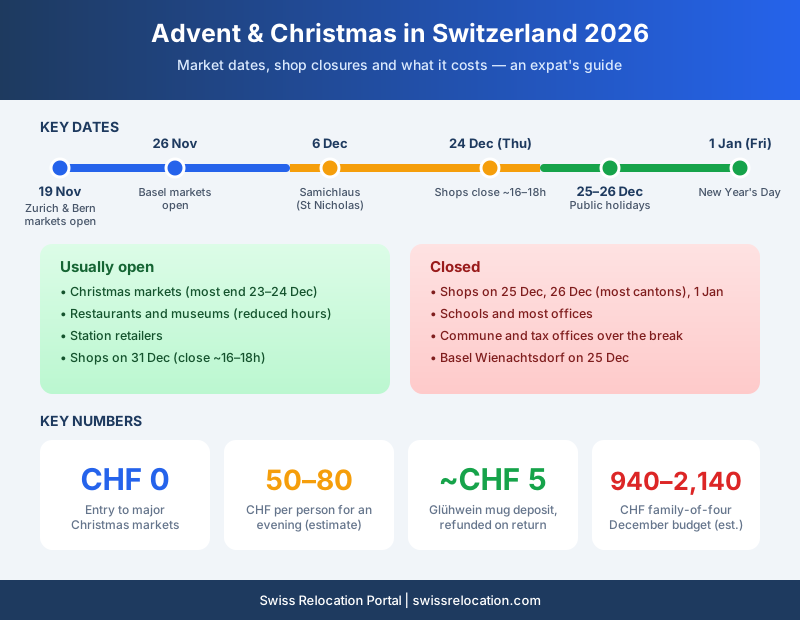
The 2026 Calendar at a Glance
The way December 2026 falls on the calendar matters. Christmas Eve (24 December) is a Thursday, Christmas Day is a Friday, and Stephen's Day (26 December) is a Saturday. New Year's Eve is a Thursday, 1 January 2027 is a Friday, and Berchtoldstag (2 January) is a Saturday. That produces two long Friday-to-Sunday stretches, and it means the "dead days" between the holidays are only a handful of working days (28–31 December) that many Swiss employers treat as an informal bridge period.
| Date (2026/27) | Weekday | What happens |
|---|---|---|
| 19–20 Nov | Thu–Fri | Zurich, Bern, Montreux and Lucerne markets open (dates vary by market) |
| 26 Nov | Thu | Basel Christmas Market and Basler Wienachtsdorf open |
| 29 Nov | Sun | First Advent Sunday |
| 6 Dec | Sun | Samichlaus (St Nicholas Day), also the second Advent Sunday |
| 24 Dec | Thu | Christmas Eve: family dinner, most shops close mid-afternoon |
| 25 Dec | Fri | Christmas Day: public holiday in every canton |
| 26 Dec | Sat | Stephen's Day: public holiday in most cantons |
| 31 Dec | Thu | New Year's Eve: not a public holiday, shops close early |
| 1 Jan 2027 | Fri | New Year's Day: public holiday everywhere |
| 2 Jan 2027 | Sat | Berchtoldstag: holiday in many German-speaking cantons |
The rule of thumb is that 25 December and 1 January are universal, while 26 December and 2 January depend on where you live and work.
Christmas Markets in 2026: Dates You Can Plan Around
Swiss Christmas markets are less about mass tourism than about local neighbourhood life: a few dozen chalets, a stage with a brass band, and a queue for mulled wine. The big ones draw crowds from across the country, so timing matters.
Based on the dates published by the organisers and travel guides at the time of writing, these are the main fixtures. Always confirm on each market's own website before travelling, because some organisers adjust hours late in the autumn.
Zurich
Zurich has several markets rather than one. Bellevue Noël on Sechseläutenplatz, Dörfli in the Niederdorf and Weihnachtsallee on Europaallee are listed as running 19 November to 23 December. Polarzauber in the main hall of Zurich Hauptbahnhof and the Münsterhof market beside the Fraumünster run 19 November to 24 December. Entry to the main markets is free; a timed ticket is only needed for the elevated wreath attraction at Bellevue.
Basel
Basel is widely regarded as the most atmospheric of the big markets. The Basel Christmas Market (Barfüsserplatz, Münsterplatz and Claraplatz) runs 26 November to 23 December. The Basler Wienachtsdorf around Theaterplatz and the Elisabethenkirche runs longer, 26 November to 3 January 2027, though it is closed on Christmas Day itself.
Bern, Lucerne, Montreux, Einsiedeln
- Bern: the Sternenmarkt at Kleine Schanze runs 19 November to 27 December; the Waisenhausplatz market 27 November to 24 December; the Münsterplatz market 28 November to 24 December.
- Lucerne: Rudolf's Christmas at the Inseli runs 20 November to 23 December; the smaller Lozärner Wiehnachtsmärt at Franziskanerplatz runs 3–20 December.
- Montreux: Montreux Noël on the lakefront runs 20 November to 24 December. Published hours are roughly 11:00–21:00 early in the week, later on Thursday to Saturday, and shortened to 11:00–17:00 on 24 December.
- Einsiedeln: one of the most traditional markets, running 27 November to 6 December in front of the monastery.
Lausanne's Bô Noël is listed as running 20 November to 31 December, which makes it one of the longest-running options in French-speaking Switzerland.
When to Go
Weekday afternoons are the quietest; Friday and Saturday evenings and the final weekend before Christmas are the busiest. If you have children or dislike crowds, go before 17:00 on a weekday. If you work in a company with a Christmas "Apéro" planned at a market, expect your colleagues to claim the evening slots first.
What an Evening at a Swiss Christmas Market Actually Costs
Entry is free at all the major markets. The cost is in what you eat and drink, and Swiss prices apply. The figures below are typical ranges quoted in 2026 travel guides rather than official tariffs, so treat them as planning assumptions.
| Item | Typical price (CHF) | Notes |
|---|---|---|
| Glühwein (mulled wine) | 5–8 | Plus a mug deposit of about CHF 5, refunded when you return it |
| Raclette portion | 8–12 | Cheese melted onto bread or potatoes |
| Fondue in a market chalet | 25–35 per person | Usually requires a seat or reservation |
| Typical evening budget | 50–80 per person | Food, drinks and one small purchase |
| Parking and tram tickets | 5–15 | Park on the outskirts and ride in |
Worked example. A couple with two children visits the Basel market on a Saturday. Two adults have a Glühwein each (CHF 6.50, so CHF 13), the children have a hot chocolate each (assume CHF 5, so CHF 10), the family shares two raclette portions (CHF 20) and buys a bag of roasted chestnuts (CHF 8). That is roughly CHF 51 before train fares, which is why a family evening quickly settles in the CHF 150–250 range once travel is included. Using the CHF 50–80 per person benchmark, four people land at CHF 200–320, before adding a fondue.
Cost-saving tips.
- Return your mug. The deposit is not a fee; forgetting it is.
- Eat a proper meal before you go and treat the market as a snack and drink stop.
- Most stalls accept contactless cards and many accept TWINT, but small artisan vendors sometimes take cash only, so carry some francs. Our first 30 days checklist explains how to set up the payment tools you will need.
- If you hold a regional or national travel pass, check whether it covers your route. Otherwise, compare a day return with a Saver Day Pass.
Shop, Office and Service Closures Over the Holidays
This is the section that saves new arrivals the most stress. Swiss holiday closures are real closures, not a suggestion.
Christmas Eve (Thursday 24 December)
Most shops close between about 16:00 and 18:00. Supermarkets in train stations and large airports often stay open longer, but your neighbourhood Migros or Coop will probably shut early. Buy everything you need by midday, including bread, because bakeries sell out.
25 and 26 December
Christmas Day is a public holiday in all cantons, and 26 December is a public holiday in most. Shops, schools and offices are closed. Restaurants, museums and some station retailers stay open, often with reduced hours. Because 26 December falls on a Saturday this year, you lose less working time than in other years, but you also lose a normal shopping Saturday. Plan your last big grocery trip for 23 or 24 December.
New Year's Eve and New Year's Day
New Year's Eve is not a legal holiday, so most shops open but close around 16:00–18:00. New Year's Day (Friday 1 January 2027) is a public holiday everywhere. Berchtoldstag on Saturday 2 January is an official holiday in cantons such as Zurich, and it largely overlaps with a weekend this year.
Sunday Shopping in December
Swiss rules on Sunday opening are set by the cantons and are restrictive. Some cantons allow a limited number of Advent Sundays, and shops in train stations and tourist areas have separate exceptions. Because the specifics differ canton by canton, check your local commune's website rather than assuming a store near you will open on a given Sunday.
Administrative Closures
Commune offices, tax offices and the cantonal migration office typically close from 24 December through early January or run a skeleton service. If you have a permit renewal, registration or tax filing pending, do not leave it until the last week of December. Submit it before 15 December, because processing queues lengthen after the holidays. If you are checking whether your permit application or renewal timeline is affected, the Permit Checker will show you the standard process so you can see how much buffer you need.
The 13th-Month Salary and December Bonuses: How They Are Taxed
December is when many Swiss employees receive their second half of a 13th-month salary or a year-end bonus. If you are new to the Swiss payroll system, a few facts help.
A 13th-month salary is not a legal requirement in Switzerland. It exists only if your employment contract or your company's collective labour agreement provides for it. Many employment contracts quote an annual salary divided into twelve or thirteen instalments, so read yours carefully. If the contract states a 13th month, it is part of your agreed pay and is typically paid in December or split between June and December. A discretionary bonus (Gratifikation) is different: the employer can decide whether and how much to pay unless the contract or consistent past practice makes it a binding entitlement.
For tax purposes, both are ordinary employment income. Social security deductions (AHV, IV, EO and unemployment insurance) apply, as does tax at your marginal rate. This is why a December bonus rarely feels as large as the headline figure: the portion that lands in your account can be noticeably lower than expected because it is stacked on top of your regular income. The effect is stronger if you are taxed at source and your monthly payslips are calculated using an annualised rate, which is covered in detail in our Quellensteuer guide.
Worked example (illustrative). Suppose your annual contract is CHF 130,000 paid in 13 instalments of CHF 10,000. Your regular monthly gross is CHF 10,000, and the 13th payment arrives in December. In a canton with a combined marginal rate of, say, 30 per cent on the next franc plus roughly 6.4 per cent employee social contributions (AHV/IV/EO and ALV, which are approximate and vary with the ceiling for unemployment insurance), the net of that extra CHF 10,000 could be around CHF 6,300. The exact amount depends on your canton, marital status and other income. To see your own number instead of an assumption, run your figures through the Tax Estimator.
Planning tip. If you receive a bonus in December, December is also the last month to maximise deductible contributions for the current tax year. A voluntary pillar 3a payment reduces taxable income for the year in which it is paid. We explain limits and deadlines in our pillar 3a guide for expats.
Swiss Advent and Christmas Traditions You Will Encounter
Customs differ between regions, but a few are close to universal and will surface at school, in your building or at work.
The Advent Calendar and Advent Wreath
Families light one candle on each of the four Advent Sundays. In 2026 these fall on 29 November and 6, 13 and 20 December. Many offices and apartment buildings decorate a shared wreath, and your children's classroom almost certainly has one.
Samichlaus (6 December)
St Nicholas visits on 6 December, often accompanied by a dark-robed companion called Schmutzli in German-speaking Switzerland. Schools, kindergartens and villages organise visits, and parents can sometimes book a Samichlaus to visit their home. Children are given nuts, mandarins, gingerbread and a Grittibänz, a sweet bread man. If a Samichlaus visit is announced at your child's school, expect a short parental contribution towards the sweets.
Guetzli Baking
Swiss families bake dozens of Christmas biscuits (Guetzli) such as Mailänderli, Zimtsterne and Brunsli, often weeks in advance. Supermarkets stock butter, hazelnuts and cutters from early November.
Christmas Eve at Home
For most Swiss families the main celebration is the evening of 24 December: a meal (fondue chinoise, a roast or a raclette are common), carols, and gifts. Christmas Day is for visiting family. If a Swiss colleague invites you for Christmas, the invitation will almost always be for the 24th or the 25th lunch.
New Year and Silvesterchläuse
The Swiss mark New Year with fireworks and, in Appenzell, the Silvesterchläuse tradition of costumed groups walking from house to house. Fireworks restrictions vary by commune, so check local rules before buying anything for 31 December.
Costs to Budget For: Gifts, Food and Travel
The market evening is only one part of the season. A realistic December budget for a household includes gifts, food and travel. The table below shows planning ranges that you can adjust; they are assumptions to help you think about your own budget, not statistical averages.
| Category | Modest | Comfortable | Notes |
|---|---|---|---|
| Gifts for a family of four | CHF 300 | CHF 800 | Depends on extended-family obligations |
| Christmas Eve and Day meals | CHF 120 | CHF 300 | Fondue or raclette for 4–6 is a cheaper option than a roast |
| Market visits (2 outings, 4 people) | CHF 400 | CHF 640 | Using the CHF 50–80 per person benchmark per visit |
| Train travel for a family trip | CHF 60 | CHF 250 | Varies with passes and routes |
| Decorations, tree and candles | CHF 60 | CHF 150 | Real trees are sold at garden centres and supermarkets |
Added together, a modest Swiss Christmas for four lands around CHF 940 and a comfortable one around CHF 2,140. If that sounds high, remember that the broader cost of living in Switzerland is high and that December adds a seasonal spike on top of rent, health insurance and childcare. Our guide on how much money you really need to live in Switzerland shows where this one-off peak sits in a typical annual budget.
Travelling Over the Holidays
Switzerland is a winter-holiday destination, and the days around Christmas and New Year are among the busiest on the rail network and the roads leading to ski areas.
- Trains: Reserve seats early on popular routes and book your tickets before the week of Christmas if you can.
- Roads: Expect heavy traffic towards the Gotthard and Alpine ski resorts on the Saturday before Christmas and on 26–27 December. Check that you have the motorway vignette and winter tyres if you drive.
- Health cover while travelling: Check your health insurance supplement for cover abroad. Our health insurance guide explains the difference between the basic and supplementary options.
- Pets, children and school holidays: Public school holidays are set by each canton, so your Christmas break could start on different dates than a friend in another canton. Check your school's calendar rather than relying on national rules. If your children attend a private school, see our international schools guide.
Practical Checklist: Your First Swiss Christmas
Use this list in the order shown.
- Mid-November: Check your employment contract for a 13th-month salary or bonus and note when it will be paid. Block time in your calendar for any permit, registration or tax paperwork you want done before the offices close.
- Late November: Choose which markets you will visit and note the opening dates. Book accommodation if you plan to travel to Basel, Montreux or Einsiedeln on a weekend.
- By 6 December: Find out whether your child's school or your building is organising a Samichlaus visit and whether a contribution is expected.
- By 15 December: Submit any outstanding paperwork to your commune or cantonal migration office. Consider your pillar 3a contribution for the tax year, and check the payment deadline with your provider.
- Mid-December: Order your main groceries and plan your menu. Buy gifts early, because online delivery by Swiss Post slows down in the last week before Christmas.
- 22–23 December: Complete your major shopping trip. Check opening hours for your supermarket on 24 December.
- 24 December: Shop for fresh bread and perishables before about 14:00 and be home by the time the shops close.
- 25–26 December: Do not plan errands. Have cash available for small vendors if you travel.
- 28–31 December: Many Swiss offices are quiet. Use the days to review your budget for January, when the new health insurance premiums, rent adjustments and tax instalments arrive.
FAQ
Is Christmas Day a public holiday everywhere in Switzerland?
Yes. 25 December is a public holiday in all cantons. 26 December (Stephen's Day) is a holiday in most cantons, but not all, so check with your employer. New Year's Day (1 January) is a public holiday everywhere, while 2 January (Berchtoldstag) is observed in a number of German-speaking cantons including Zurich.
Can I shop on Christmas Eve and New Year's Eve?
Yes, but shops close early. Expect most to close between about 16:00 and 18:00 on both days, with bigger stores and station shops sometimes staying open longer. Neither day is a legal holiday, but many employers give a half-day off. Buy what you need before midday to avoid empty shelves.
Do I get a 13th-month salary in Switzerland?
Only if your contract or collective agreement says so. Switzerland has no statutory 13th month, and many employers instead pay a twelve-month salary with a separate discretionary bonus. Check the wording in your employment contract. If a 13th month is promised in writing, it is part of your agreed pay, and the employer cannot simply cancel it. If you leave mid-year, the contract usually prescribes a pro-rata share.
Are Swiss Christmas markets free to enter?
Yes. Entry to the major markets in Zurich, Basel, Bern, Lucerne and Montreux is free. You pay for food, drinks and crafts. Some special attractions, like the elevated wreath at Zurich's Bellevue Noël, require a timed ticket. Expect to pay a mug deposit of roughly CHF 5 on mulled wine, which is refunded when you return the mug.
When is Samichlaus and what do I have to do?
Samichlaus is celebrated on 6 December. Schools and kindergartens often organise a visit, and some families book a Samichlaus to visit at home. You do not have to do anything formal, but check with your child's teacher in case a small contribution or a bag of mandarins and nuts is expected.
How is a December bonus taxed?
A bonus is ordinary employment income. Social security contributions and income tax apply, and the extra income is taxed at your marginal rate. In practice, this means the net amount can be substantially lower than the gross. If you are taxed at source, your employer applies the withholding rate to the bonus. You can use the Tax Estimator to see how an extra payment affects your yearly tax bill.
What This Means for You
Your first Swiss Christmas is easier than it looks if you remember three things: shops close early on 24 December and stay closed on 25 and 26 December, markets cost very little to enter but plenty to enjoy, and December is when your contract's bonus clauses and tax deadlines matter most. Plan groceries, paperwork and travel around the closures, set a realistic budget in the CHF 940–2,140 range for a family of four, and decide in advance which traditions you want to join.
Next Step: See What Your December Payment Is Really Worth
If your contract includes a 13th-month salary or you expect a year-end bonus, the quickest way to avoid surprises is to estimate the real net amount in your canton. Try the Swiss Tax Estimator to model your income, compare cantons and see how an extra payment changes your tax bill before it lands in your account.
Premium Downloads
Get the Complete Relocation Checklist
Download our step-by-step PDF guides covering banking, insurance, housing, and everything you need for your Swiss move.
This portal is built by an expat, for expats. If it saved you time, buy me a coffee.
Buy me a coffee