Switzerland's 29 November 2026 Votes: What the VAT Hike, Couples-Tax Initiative and War Material Act Mean for Expats
Switzerland's 29 November 2026 Votes: What the VAT Hike, Couples-Tax Initiative and War Material Act Mean for Expats
On Sunday 29 November 2026, Swiss voters decide on four federal items. Most expats cannot cast a ballot, so it is tempting to ignore the campaign posters and the voting booklet that lands in your neighbours' mailboxes. That would be a mistake. Two of the four items change what you pay: a VAT increase on almost everything you buy, and an initiative that could rewrite how married couples are taxed at federal level, only months after voters approved individual taxation. A third item, the War Material Act, is mostly about foreign policy, but it shapes how Switzerland's neutrality is perceived abroad. The fourth, the fireworks initiative, decides what your New Year's Eve may look like and has its own guide on the portal.
This guide explains each item in plain language, what the polls say, what changes for you in CHF terms, and what to do now. Quick orientation: the numbers below come from the Federal Council's voting information, the parliamentary vote counts and a YouGov poll reported in Swiss media. Official results arrive on the evening of 29 November, so treat the polls as a snapshot, not a forecast.
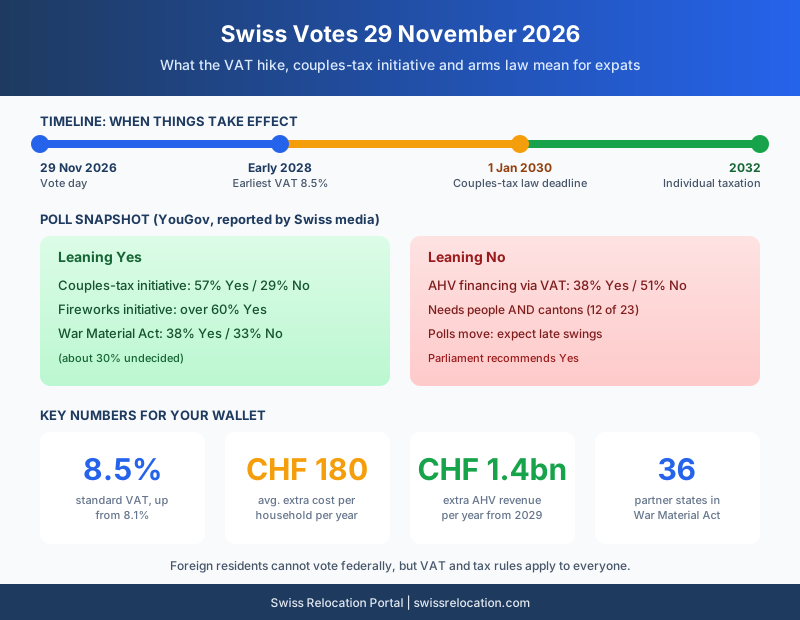
The Short Version: Four Items, Two That Hit Your Wallet
| Item | What it is | Majority needed | Federal Council / Parliament | Poll snapshot |
|---|---|---|---|---|
| AHV financing via VAT | Standard VAT 8.1% to 8.5% | People and cantons | Yes | 38% Yes, 51% No |
| Couples-tax initiative | Joint federal taxation for married couples | People and cantons | No | 57% Yes, 29% No |
| War Material Act change | Easier arms exports to 36 partner states | People only | Yes | 38% Yes, 33% No, about 30% undecided |
| Fireworks initiative | Ban on noisy private fireworks | People and cantons | See dedicated guide | Over 60% Yes |
Poll figures are from a YouGov survey reported by Swiss media and were taken before the final campaign weeks. Late swings of 5 to 10 points are normal in Swiss votes, especially on tax and pension questions where opposition often grows near the deadline.
Can You Vote? A 60-Second Reality Check
Foreign nationals have no right to vote in federal ballots, and that includes holders of B, C, L and G permits. Some cantons and municipalities do grant limited rights. Neuchâtel and Jura allow foreign residents to vote at cantonal level after a residence period, and Geneva, Vaud and Fribourg offer municipal voting rights in various forms. Federal votes, however, remain a citizens-only matter. If you are on the path to naturalisation, our citizenship guide explains the residence requirements and what changes with the 2026 reform debate.
Being unable to vote does not mean being unaffected. The first two items below will change prices and tax bills, and you can prepare for them regardless of the outcome.
Item 1: Financing the 13th AHV Pension Through VAT
Background
In March 2024 voters approved a 13th monthly AHV pension, paid for the first time in December 2026. That decision created a bill of roughly CHF 4 billion per year at the start, and it grows as the retiree population grows. The vote on 29 November is not about whether the 13th pension exists. It is about how part of the cost is financed.
The first 13th payment in December 2026 comes out of the existing AHV fund and does not depend on this vote.
What exactly is proposed
- The standard VAT rate rises by 0.4 percentage points, from 8.1% to 8.5%.
- The special rate for hotel accommodation rises from 3.8% to 4.0%.
- The reduced rate of 2.6% on food, medicines, books and similar essentials stays unchanged.
- The increase takes effect no earlier than early 2028, on a date the Federal Council sets.
- Expected revenue: about CHF 1.4 billion per year from 2029, which the Federal Council says covers roughly half of the 13th pension's added costs together with the federal contribution.
Because this changes the constitution, it needs a double majority: more than half of voters and more than half of the cantons.
What it costs you
The Federal Tax Administration estimates an average additional cost of about CHF 180 per household per year. Your own figure depends on how much of your spending carries the standard rate. Use this rule of thumb: the effective increase is about 0.37% of your taxable spending (8.5 / 108.1 compared with 8.1 / 108.1 of the gross price).
| Annual spending at the standard rate | Approximate extra VAT per year |
|---|---|
| CHF 30,000 (single, modest lifestyle) | about CHF 110 |
| CHF 50,000 (couple, mid-range) | about CHF 185 |
| CHF 80,000 (family, higher spend) | about CHF 295 |
| CHF 120,000 (high-spending household) | about CHF 445 |
These are illustrative calculations using the rate change applied to spending at the standard rate. Groceries are excluded because they sit at the 2.6% rate. Restaurants, clothing, electronics, services, cars and most subscriptions are at the standard rate.
Why it matters beyond the number
VAT is the one tax every resident pays, including Quellensteuer taxpayers and people who earn little. Swiss payroll deductions for AHV are already 5.3% on the employee side (and 5.3% employer side) on your gross salary. If you are a non-Swiss worker planning to leave, remember that AHV contributions can be partly reclaimed only under specific conditions that depend on your nationality and any social security agreement. Our health insurance guide covers the other big fixed cost in your budget, and the broader cost of living comparison shows how a 0.4-point VAT change compares with the much larger swings between cantons.
Arguments, briefly
Supporters say financing the 13th pension through consumption spreads the cost across all generations, including pensioners who spend money too, and protects wages from higher payroll contributions. Opponents argue that a consumption tax hits low earners harder relative to income, that businesses and SMEs face price pressure, and that structural reform such as a higher retirement age should come first. In parliament the National Council voted 108 to 85 with 6 abstentions in favour, and the Council of States 28 to 13 with 3 abstentions.
Why the poll looks difficult
The YouGov figure of 38% Yes to 51% No suggests a hard road, and the cantonal majority makes it harder: a rural, low-VAT-tolerance canton counts the same as Zurich. If the proposal fails, the financing question returns to parliament, and the likely alternatives are higher payroll contributions, a different VAT path or structural reform. For household planning, a No does not mean the bill disappears. It means the bill arrives in a different form, probably later.
Item 2: The Couples-Tax Initiative ("Ja zu fairen Bundessteuern auch für Ehepaare")
Background: why this vote comes so soon
On 8 March 2026, Swiss voters narrowly approved individual taxation (54.26% Yes), ending the so-called marriage penalty by taxing each spouse separately. We explained the reform in our individual taxation guide. The Mitte party submitted this initiative before that vote and it now reaches the ballot, creating an unusual situation: voters could approve a framework in March and a competing principle in November.
What the initiative demands
- The constitution would state that spouses' incomes continue to be combined for the direct federal tax, without disadvantaging married couples.
- Parliament would have to pass an implementing law. If no law is in force by 1 January 2030, the Federal Council must introduce an alternative calculation.
- That alternative: the couple's federal tax is computed twice, once jointly and once as two unmarried individuals, and the couple pays the lower amount.
- Cantonal taxes are not directly changed. Individual taxation is scheduled for 2032 and would still apply unless the law changes.
Estimated relief for couples ranges from CHF 680 million to CHF 3 billion per year depending on implementation, which is why opponents warn of large federal revenue losses.
What it could mean for an expat couple
The direct federal tax is the smaller part of most bills. A rough picture for a couple where both partners work, using round numbers for illustration:
| Scenario | Federal tax today (joint, illustrative) | Effect of lower-of-two rule |
|---|---|---|
| Dual income, CHF 90,000 and CHF 90,000 | A marriage penalty applies | Couple pays the lower of the joint and individual result, removing the penalty |
| Single earner, CHF 180,000, partner not working | Joint filing already benefits the couple | Joint treatment would likely stay in place |
| Dual income, CHF 140,000 and CHF 40,000 | Penalty is moderate | Depends on the implementing law |
Under individual taxation, the dual-income couple benefits and the single-earner couple pays more. Under the initiative, single-earner couples keep the advantage of joint treatment while dual-income couples are shielded from the penalty. That is the political compromise at its core, and its price is federal revenue.
Two important caveats for expats:
- Quellensteuer taxpayers. If you are taxed at source, the federal tax is withheld as part of the Quellensteuer tariff. Changes to the federal tax calculation would flow into tariff design, but the details are decided by the implementing law and cantonal tariffs. See our Quellensteuer guide for how the system works today.
- Timing. Nothing changes for the 2026 or 2027 tax years. The earliest practical effects come around 2030, and individual taxation is already slated for 2032.
Positions and numbers
The Federal Council and Parliament recommend a No. The National Council voted 102 to 97 against, and the Council of States 24 to 20 against, which are narrow margins. The YouGov poll shows 57% Yes, 29% No and 14% undecided, a more comfortable lead than the other items, but initiatives often lose support during the campaign. Passing requires both the popular and the cantonal majority.
What to do now
If you are married or planning to marry before 2030, do not restructure your life around this vote. Instead, run your numbers: the Tax Estimator lets you compare cantons and see how a joint or individual calculation affects your net income. If the initiative passes, the lower-of-two principle will matter most for dual-income couples in cantons with steep progression, such as Geneva or Vaud.
Item 3: Amendment to the War Material Act
What changes
Parliament loosened the rules for exporting Swiss war material in December 2025, citing the changed security situation in Europe. A referendum, mostly from left-leaning parties and organisations, forced a public vote.
- Today, exports to countries involved in an armed conflict are not permitted. The change would allow sales to 36 Western partner states even if they are in a conflict. The list covers all EU and EFTA states except Liechtenstein, plus Argentina, Australia, Japan, Canada, New Zealand, the United States and the United Kingdom.
- Buyers would no longer have to give a non-re-export guarantee in every case. The Federal Council could still demand one for foreign policy, neutrality or security reasons, and could block deliveries to partner states at war.
- According to the Federal Council, direct or indirect deliveries to Ukraine would remain impossible.
This is an optional referendum, so only a majority of voters is needed, not a cantonal majority.
Why an expat should care
This is the least personal of the four items, but it carries a reputational and business dimension. The Swiss defence and machinery industry employs many foreign specialists, and Switzerland's neutrality is part of why international organisations are headquartered in Geneva. Supporters say a domestic defence industry is part of armed neutrality and protects jobs and know-how. Opponents warn of weapons reaching abusive states and of weakened credibility for Swiss neutrality.
Parliament backed the change: the National Council 122 to 68 with 6 abstentions, and the Council of States 31 to 11 with 1 abstention. Polls are the most open of the four: 38% Yes, 33% No and roughly 30% undecided, with a large gender gap (about 50% of men in favour versus 28% of women).
If you work in engineering, aerospace or machinery in cantons such as Zurich, Zug, Thurgau or Ticino, ask your employer whether export licensing affects your project pipeline. For most readers, the practical consequence is zero.
Item 4: The Fireworks Initiative
The fourth item would ban the sale and use of noise-producing fireworks, with exceptions possible for large public events. Polls show over 60% Yes, with women (69%) far more supportive than men (54%). The 2026 New Year's Eve is not affected by the outcome because of the implementation window. Our dedicated New Year's Eve guide covers city-by-city rules and what to expect if you live near a lake promenade. Check the blog for the latest.
How the Swiss Double Majority Works (and Why It Matters)
Three of the four items require both a popular majority and a majority of the cantons (the Ständemehr). The cantons carry 23 votes in total: 20 full cantons and 6 half cantons, each half counting as half a vote. At least 12 are needed, and a 11.5 to 11.5 tie counts as a rejection.
That rule has consequences. Rural and smaller cantons weigh the same as Zurich, Vaud or Geneva, so a proposal can win nationally and still fail. For the VAT item, the cantonal map is a risk factor on top of a weak national poll. For the couples-tax initiative, a conservative-leaning rural block helps the Yes side.
Timeline: What Happens After 29 November
| Date | What happens |
|---|---|
| 29 November 2026 | Vote; results on the evening, cantonal breakdown the same night |
| December 2026 | First 13th AHV pension payments (independent of the VAT vote) |
| Early 2027 | If VAT passes: Federal Council sets the implementation timetable |
| Early 2028 | Earliest start of the higher VAT rate |
| 2029 | First full year of expected CHF 1.4 billion extra AHV revenue |
| 1 January 2030 | Deadline for the couples-tax implementing law if the initiative passes |
| 2032 | Scheduled start of individual taxation |
What This Means for You: Practical Checklist
- Budget for VAT. Add 0.4% to your standard-rate spending for 2028 and later. For most households that is a few hundred francs per year, well below the difference between cantonal rents.
- Do not change your marriage or filing plans yet. The couples-tax initiative changes nothing before 2030, and individual taxation is already law for 2032.
- Run your tax numbers now. Use the Tax Estimator to model joint and separate scenarios in your canton.
- Check your permit timeline. The votes do not change permit rules. If your permit status is uncertain, the Permit Checker shows what applies to your nationality.
- Follow the results, not the posters. Official results and the cantonal map appear on the evening of 29 November at admin.ch and in major Swiss media.
- Talk to your employer about the War Material Act only if you work in the defence or export sector.
- If you aim for citizenship, track the residence requirements early, because voting rights arrive only with naturalisation.
Frequently Asked Questions
Can I vote on 29 November if I have a C permit?
No. Federal voting rights require Swiss citizenship regardless of permit type or length of stay. Some cantons and municipalities allow foreign residents to vote on local matters, but not on these federal items.
Will VAT go up immediately if the AHV financing passes?
No. The earliest start is early 2028, and the Federal Council sets the exact date. Nothing changes in 2026 or 2027.
Does the VAT increase apply to groceries and rent?
Groceries, medicines and similar essentials keep the reduced 2.6% rate. Rent is exempt from VAT in the normal case. Restaurants, clothing, services and most goods carry the standard rate.
If the couples-tax initiative passes, will I pay less tax next year?
No. It requires an implementing law by 2030, and the federal tax is only one part of your total bill. Cantonal and communal taxes follow the cantonal individual-taxation schedule unless the law changes.
I am a Quellensteuer taxpayer. Does the initiative affect me?
Possibly, in the longer term. Source tax tariffs reflect the federal tax calculation, so changes would be built into future tariffs. For now your withholding is unchanged, and our Quellensteuer guide explains when an ordinary assessment may be worth requesting.
What happens if all four items fail?
The status quo continues. The 13th pension still gets paid, and parliament would need a new financing proposal. Individual taxation from 2032 remains law, and fireworks and war material rules stay as they are.
Your Next Step
The votes decide what Switzerland looks like in 2028 to 2032, but your tax position is something you can model today. Open the Swiss Tax Estimator, enter your income and canton, and compare joint and individual scenarios before the results arrive on 29 November.
Premium Tool
Calculate Your Swiss Tax Savings
Use our canton-by-canton tax estimator to see exactly how much you'll pay — and how the 2026 reform affects your household.
This portal is built by an expat, for expats. If it saved you time, buy me a coffee.
Buy me a coffee